When I first wrote this post years ago, I presented syllable division as a series of rules students should follow whenever they encountered a multisyllabic word. Since then, I’ve spent so many hours studying the research on multisyllabic word reading, teaching students, creating morphology courses, and learning from researchers and educators whose work has deepened my own understanding of how skilled readers actually process larger words.
As my understanding has grown, so has my teaching. So rather than delete this post altogether, I’ve chosen to update it.
You might notice that many of the syllable division patterns are still here. I still teach them! But I no longer teach them as rigid rules students must memorize or follow perfectly. Instead, I teach them as helpful patterns that can guide students toward an approximate pronunciation.
Research increasingly suggests that successful readers don’t rely on one fixed procedure when reading bigger words. Instead, they coordinate multiple sources of information at once. They use their knowledge of letter-sound correspondences, syllables, morphology, vocabulary, and meaning. They remain flexible, adjusting vowel sounds and stress patterns until they arrive at a word they recognize.
The goal isn’t perfect syllable division. The goal is successful word reading. That shift has completely changed how I teach multisyllabic words.
Throughout this post, you’ll still learn the common syllable division patterns because I believe they’re useful tools. But you’ll also see how I now weave in morphology, set for variability, flexible vowel pronunciation, and meaning so students develop the problem-solving skills that skilled readers use every day.
My hope is that this updated version gives you a more complete picture of how to help students tackle bigger words with confidence.
Reading Bigger Words Requires More Than One Strategy
It’s important to understand what skilled readers are actually doing when they encounter an unfamiliar multisyllabic word.
Skilled readers coordinate multiple sources of information at the same time. They use what they already know about letter-sound correspondences, syllables, meaningful word parts, pronunciation, and vocabulary to work toward the correct word. If their first attempt doesn’t sound quite right, they don’t assume they’ve failed. They adjust, try another likely pronunciation, and continue making sense of the word.
That’s why flexibility is such an important part of successful word reading.
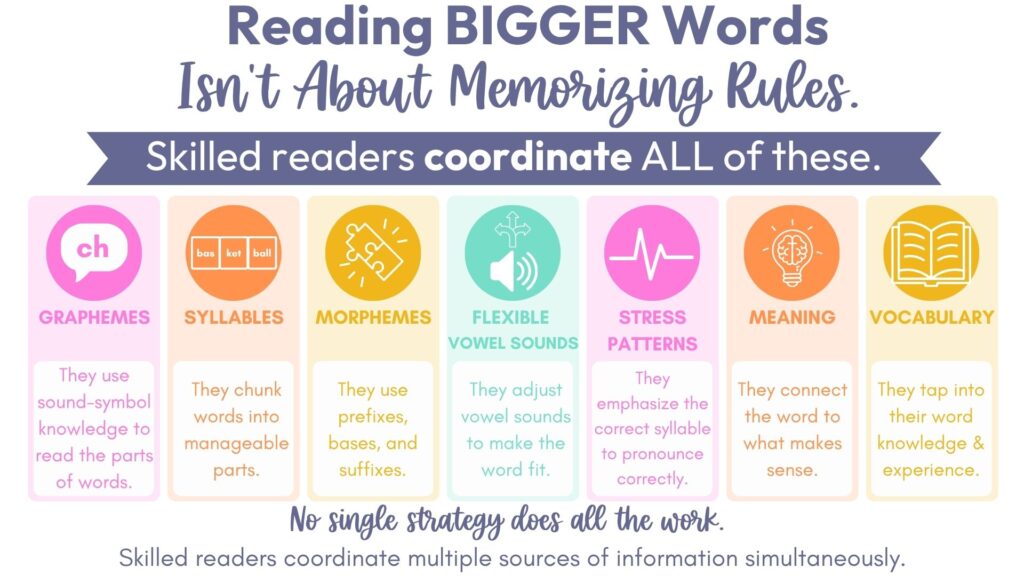
As you read through this post, keep this graphic in mind. Every strategy we’ll discuss fits somewhere within this larger framework.
Why Are Bigger Words Harder to Read?
When students first learn to read, most of their attention is focused on one thing: matching graphemes (letters and letter combinations) to sounds. For many one-syllable words, that’s enough.
But as words become longer, the task becomes much more complex. Students are no longer relying on phonics alone. Instead, they’re coordinating multiple sources of information at the same time. They still use their knowledge of graphemes and phonics patterns, but they also begin recognizing syllables, familiar prefixes, suffixes, and bases. They draw on their oral vocabulary, consider the meaning of the sentence, and remain flexible with vowel sounds and stress patterns.
That’s because English isn’t just a sound-based writing system. It’s a morphophonemic writing system, meaning our spelling system represents both pronunciation and meaning. (Learn more about morphology here.) On top of that, English has borrowed words and spelling patterns from many different languages over hundreds of years.
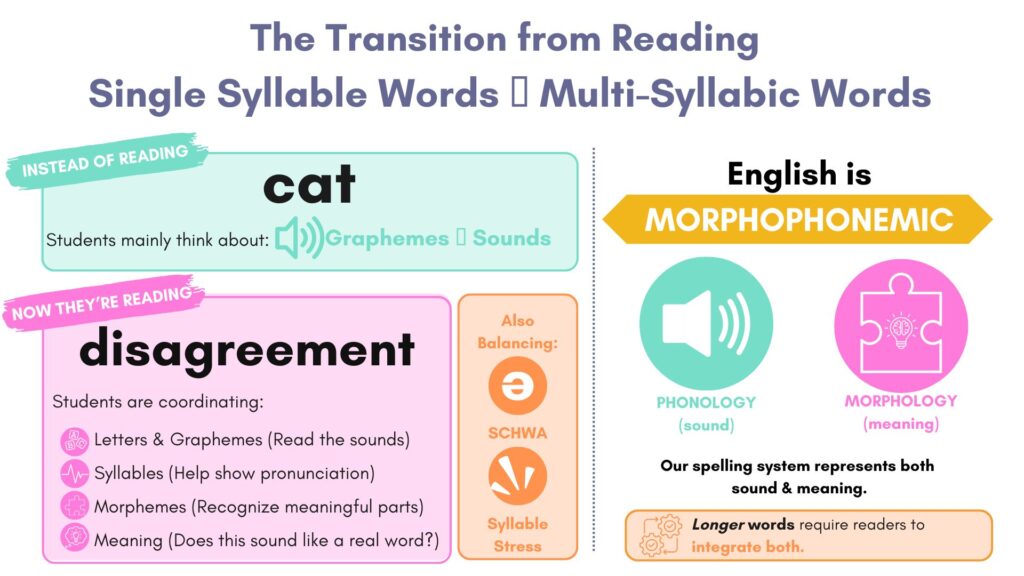
Instead of seeing a long word as one overwhelming string of letters, skilled readers gradually learn to recognize meaningful chunks and use those chunks to guide pronunciation and meaning.
Understanding this changes how we teach. Rather than looking for one “magic strategy” for multisyllabic words, we want students to learn how to coordinate all of these sources of information together.
How to Teach Students to Read Bigger Words
As I mentioned earlier, my routine for teaching multisyllabic words has changed quite a bit. I used to spend much more time teaching students where to divide words. Today, my focus is on helping students become flexible problem-solvers.
When students encounter an unfamiliar multisyllabic word, I want them to move through a consistent routine. The steps aren’t meant to be rigid or mechanical. Instead, they encourage students to coordinate the different sources of information we just discussed.
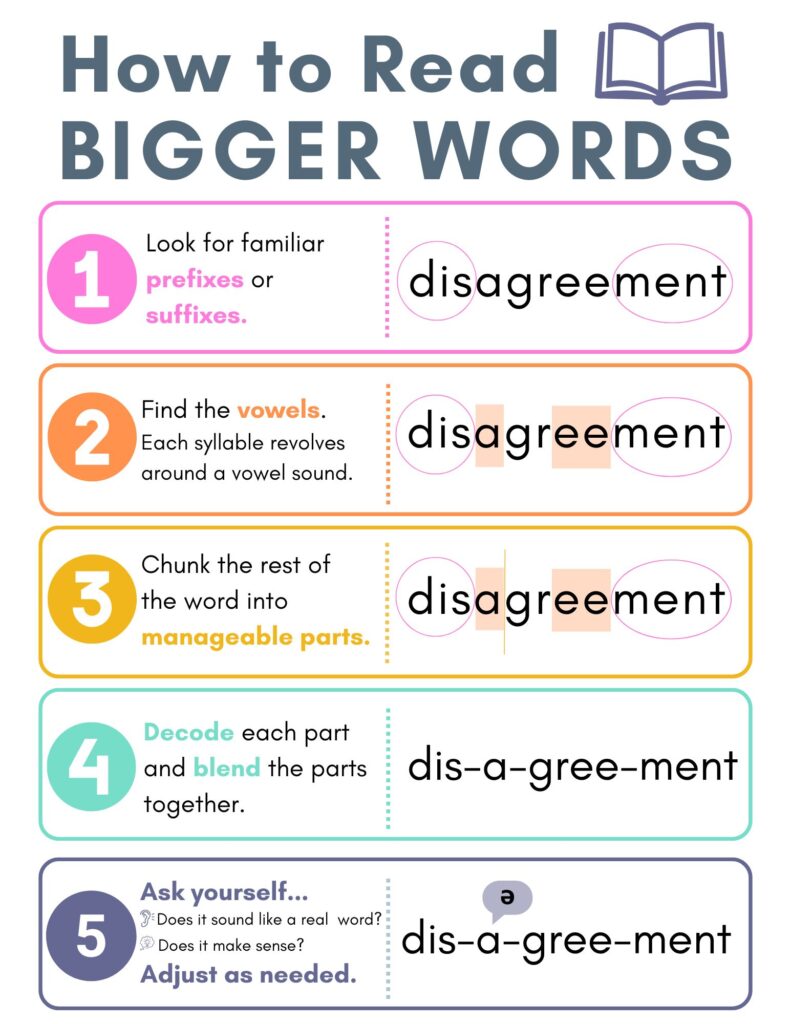
Step 1: Look for familiar morphemes.
Before thinking about syllable division, I encourage students to look for any familiar prefixes, suffixes, or bases. Recognizing meaningful parts often makes a long word much less intimidating.
For example, in the word disagreement, students might immediately recognize dis- and -ment. Instead of one long word, they’re now working with three familiar chunks.
Step 2: Find the vowels.
If the word doesn’t contain obvious morphemes (or after identifying the morphemes), we locate the vowels. Every syllable contains one vowel sound, so identifying the vowels helps students estimate how many syllables they’re working with.
It’s important to note that this can be a vowel letter, a vowel team, or an r-controlled vowel. Students need to look for the grapheme that represents the vowel sound. When working with students, this is something to look out for. If you see a student underline the <a> instead of <ar>, that is the perfect teachable moment.
Step 3: Break the word into manageable parts.
Next, students divide the remaining letters into pronounceable chunks. Sometimes morphology guides those chunks. Other times, common syllable patterns help us decide where to make an initial split. We’ll take a closer look at those patterns later in this post.
The important thing is creating manageable parts that students can decode.
Step 4: Decode each part and blend together.
Students read each chunk using what they know about graphemes, vowel patterns, and syllable types. Then, they combine the chunks to read whole word.
The key here is not expecting the first attempt to be perfect. Sometimes students will pronounce the word correctly right away. Other times, they may need to adjust a vowel sound, account for a schwa, or shift the stress pattern. Skilled readers do this naturally, but many students need explicit instruction, teacher modeling, and guided practice to develop this flexibility.
Step 5: Confirm the word or adjust
After decoding the word, students should pause and ask themselves two simple questions:
- Does it sound like a real word?
- Does it make sense in the sentence?
If the answer is “no,” it’s time to adjust. Maybe the vowel needs to change. Maybe the stress belongs on a different syllable. Maybe an unstressed vowel should be pronounced as a schwa. This process is called set for variability, which is the ability to adjust a decoded pronunciation until it matches a known word. It’s something skilled readers do constantly, but it’s also something many students need to be taught explicitly.
Set for Variability: Why Flexibility Matters
Students don’t always arrive at the correct pronunciation on their first attempt. I mentioned earlier the many reasons for this. One of the most important things we can teach and model is something called set for variability.
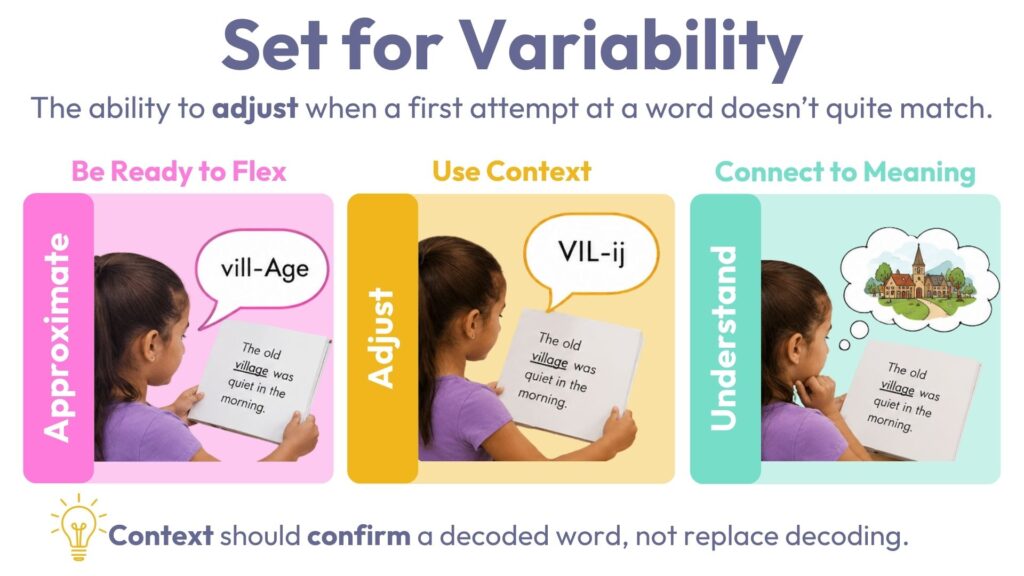
Set for variability is the ability to adjust a decoded pronunciation until it matches a real word. This is especially important when reading multisyllabic words. A student may successfully decode every grapheme in the word but still need to adjust a vowel sound, account for a schwa, or shift the stress pattern before arriving at the correct pronunciation.
That’s why I encourage students to be ready to flex. If a word doesn’t sound quite right, don’t assume you’ve failed. Instead, ask yourself, “What could I adjust?” Skilled readers make these small adjustments all the time, often without realizing it. For many students, however, this flexibility needs to be modeled, practiced, and reinforced.
Take the word village, for example. A student might initially read it as vill-Age, pronouncing the <a> as a long vowel because that’s a pattern they’ve learned in many one-syllable words. They haven’t ignored the letters or decoded carelessly. They’ve applied what they know. However, in village, the second syllable is unstressed, and the vowel is pronounced as a schwa. The student simply needs to adjust the pronunciation until it matches the spoken word they already know.
Reading longer words often requires students to first make an approximate pronunciation and then refine it.
What About Context?
You probably noticed the word context in my image above. And you might be wondering, “Didn’t the Science of Reading move away from using context?” This is an important distinction. What we moved away from was teaching students to use context instead of carefully attending to the letters in a word. The three-cueing system encouraged students to rely on pictures, sentence structure, or meaning to identify unknown words. That’s very different from what we’re talking about here.
In this routine, decoding always comes first. Students attend carefully to the letters, decode the word, and generate an approximate pronunciation. Then they use their oral vocabulary and the meaning of the sentence to determine whether that pronunciation matches a real word.
Think about the word present. Is it PRE-sent or pre-SENT? The spelling is identical. Students still have to decode the letters, but context tells them which pronunciation, and therefore which meaning, is correct. The same is true for words like record, project, conduct, and content, where the stressed syllable changes depending on how the word is being used.
Notice what happened in my example above. After decoding, the student was able to use a mixture of context, vocabulary knowledge, and possible awareness of the schwa to adjust the pronunciation and arrive at the correct word. The student didn’t use context to guess the word. They used used it refine and confirm the pronunciation they had already decoded.
Where Do Syllable Division Patterns Fit?
If you’ve made it this far, you may be wondering… “If students don’t need to memorize a long list of syllable division rules, should we teach them at all?” I think the answer varies based on your students, but perhaps not in the way many of us were taught.
I still teach common syllable division patterns because they provide students with a helpful starting point when they encounter an unfamiliar multisyllabic word. They help students break long words into manageable chunks and make an initial pronunciation attempt. It’s important to note that many students don’t need that instruction at all. If your students can read multi-syllabic words, then they don’t need this extra strategy. That’s why I think this work is best done in small groups or in an intervention.
Think of syllable division patterns as generalizations rather than rules. They’re one tool within a larger problem-solving process, not the destination itself. With that in mind, let’s look at the most common syllable division patterns and how they can support students when reading bigger words.
Getting Started with Syllable Division
Before we dive into the common syllable patterns, let’s review one important idea. A syllable is a unit of pronunciation that contains one vowel sound. Because every syllable has one vowel sound, locating the vowel graphemes gives students a helpful starting point when reading an unfamiliar multisyllabic word.
In print, identifying the vowel graphemes gives students a good estimate of how many syllables they’ll be working with. This doesn’t tell students exactly where to divide the word. Instead, it provides a framework for breaking a longer word into manageable parts.
Now that we understand what a syllable is, we can use common consonant-vowel patterns to help us make an initial split.
Remember, these patterns are generalizations, not rigid rules. Their purpose is to help students break longer words into manageable parts and make a reasonable first pronunciation attempt. If that attempt doesn’t produce a real word, students can adjust using Set for Variability.
One more reminder before we begin: always look for familiar prefixes, suffixes, and bases first. When no obvious morphemes stand out, these syllable patterns become a helpful next step.

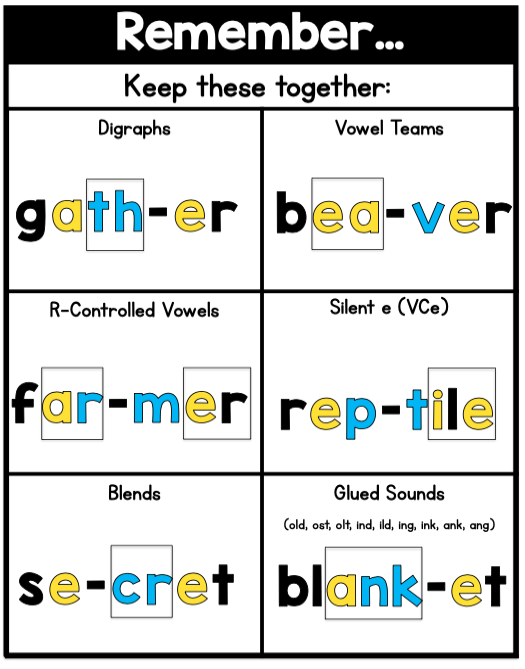
At first glance, these patterns can feel like a lot, and that’s one reason many educators have begun rethinking how syllable division is taught. As I mentioned earlier, recent research suggests that asking students to consciously remember and apply a long sequence of syllable-division rules every time they encounter an unfamiliar word may place unnecessary demands on working memory. Rather than following a rigid procedure, skilled readers appear to coordinate multiple sources of information simultaneously, adjusting their pronunciation as needed.
That doesn’t mean these patterns aren’t useful. I’ve found that some students benefit greatly from learning common syllable patterns, especially when they need support breaking longer words into manageable parts. The difference is that I no longer teach them as rules students must memorize. Instead, I teach them as flexible generalizations that can guide an initial pronunciation attempt.
With that mindset, let’s look at each of the common syllable patterns individually.
Pattern #1: Two consonants between the vowels: VCCV Pattern
One of the most common (and simple) syllable division patterns is VCCV (vowel, consonant, consonant, vowel). This one is pretty consistent. When students see this pattern, a good first attempt is to split between the two consonants.

This division creates manageable parts that students can decode and blend together.
Teaching Tips
- Check for morphemes first. Before applying any syllable pattern, look for familiar prefixes, suffixes, or bases. If students recognize meaningful word parts, those often provide a stronger guide than syllable division alone.
- Keep digraphs together. Digraphs such as sh, ch, th, and ph represent a single sound and should not be split apart.
- Be ready to flex. Even though VCCV is one of the more reliable patterns, it won’t work perfectly every time. If the first attempt doesn’t produce a word the student recognizes, encourage them to adjust rather than memorize exceptions. Take the word secret, for example. A student might first divide it as sec/ret, which naturally leads to a short e in the first syllable. If that pronunciation doesn’t sound like a familiar word, encourage them to flex the vowel sound and try se/cret instead.
Pattern #2 & 3: One Consonant between the Vowels: VCV Pattern
The VCV pattern (vowel-consonant-vowel) is one of the trickiest syllable patterns because there isn’t just one correct first attempt.
When students see one consonant between two vowels, there are two common possibilities:
Option 1: Divide Before the Consonant
In many words, dividing before the consonant creates an open syllable, so the first vowel is usually long.

Option 2: Divide After the Consonant
Dividing after the consonant usually creates a closed syllable, so the first vowel is usually short.

So which one should students try? The answer is… it depends.
This is exactly where Set for Variability comes into play. Encourage students to make one reasonable attempt, blend the word together, and ask themselves:
- Does it sound like a real word?
- Does it make sense?
If not, they simply try the other possibility.
Rather than memorizing exceptions, students learn to think flexibly and adjust their pronunciation until it matches a word they know.
Teaching tips for VCV:
- Model both possibilities. Show students how changing the division changes the vowel sound. This helps them understand why one pattern doesn’t work for every word.
- Check for morphemes first. Before applying the VCV pattern, look for familiar prefixes, suffixes, and bases. Morphology often provides a more reliable guide than syllable division alone.
- Normalize adjusting. Students should expect that their first attempt won’t always be correct. That’s not a mistake—it’s part of the reading process. Skilled readers make approximate pronunciations and refine them until they arrive at the correct word.
Pattern #4: Three consonants between the vowels.
When three consonants appear between two vowels, a common generalization is to divide after the first consonant.

One reason this often works is that the remaining consonants frequently form a blend or consonant cluster that naturally begins the second syllable.
However, before applying this pattern, I encourage students to look for morphemes. Many words with three consonants between the vowels contain familiar prefixes that provide a much stronger clue than syllable division alone. Look how much easier this is!

There are some words that do not have obvious morphemes (like pumpkin and hundred), but I’ve found that the majority of the time, words with this pattern tend to have a common prefix.
Pattern #5: Consonant -le
Consonant-le is both a syllable type and a syllable division generalization.
The consonant-le pattern is a little different from the others because it’s both a syllable type and a syllable division pattern.
When a word ends in consonant + le, that final chunk forms its own syllable.

A helpful reminder many teachers use is:
“Consonant-le…go back three!” Starting at the end of the word, count back three letters (consonant + l + e) and divide before the consonant.
Pattern #7: V/V
Students are often taught that when they see two vowels together, they should think vowel team. Most of the time, that’s exactly the right approach. However, sometimes two vowels next to each other don’t work together to represent one vowel sound. Instead, each vowel belongs to a different syllable.

Compound Words
Compound words are one place where I don’t think about syllable division at all. Instead of looking for vowel-consonant patterns, I encourage students to look for the two smaller words that combine to make the larger word.
For example:
- sun/set
- base/ball
- lamp/shade
- rain/bow
Recognizing the two bases gives students immediate access to both the pronunciation and the meaning of the word.
This is a great reminder that reading multisyllabic words isn’t always about applying a syllable pattern. Sometimes the most helpful strategy is simply recognizing meaningful word parts students already know.
Affixes: Prefixes and Suffixes
Many longer words contain familiar prefixes, suffixes, and bases that provide reliable clues for both pronunciation and meaning.
For example:
- un/help/ful → un- + help + -ful
- re/act/ing → re- + act + -ing
- trans/port/ed → trans- + port + -ed
Instead of asking, “Which syllable pattern should I use?” encourage students to ask:
- Do I recognize a prefix?
- Do I recognize a suffix?
- What’s left for the base?
Once those meaningful parts have been identified, the remaining decoding becomes much more manageable.
Morphology also gives students something syllable division alone cannot provide. It supports vocabulary and comprehension. Students aren’t just learning how to pronounce bigger words. They’re learning how words are constructed and how their meanings are connected. That’s why I spend far more instructional time teaching common prefixes, suffixes, and bases than teaching students syllable patterns. Syllable patterns are still helpful tools, but morphology gives students a much stronger foundation for reading, spelling, and understanding multisyllabic words.
Want to learn more about teaching morphology and multisyllabic words? I have a very extensive morphology course! Learn more about my morphology course here. You won’t regret learning more about how the English language really works.
3 Syllable Words:
Students will follow the same flexible routine:
- Look for familiar morphemes.
- Find the vowel graphemes.
- Chunk the remaining letters into manageable parts.
- Decode and blend.
- Adjust as needed using Set for Variability.

The longer the word becomes, the more valuable morphology tends to be. Recognizing the prefixes, suffixes, and bases immediately reduces the complexity of the word. Instead of seeing one long string of letters, students begin seeing familiar, meaningful parts. As words become longer, students naturally rely less on consciously applying syllable division patterns and more on recognizing familiar morphemes, coordinating multiple sources of information, and using Set for Variability to refine their pronunciation.

Resources for Syllable Division
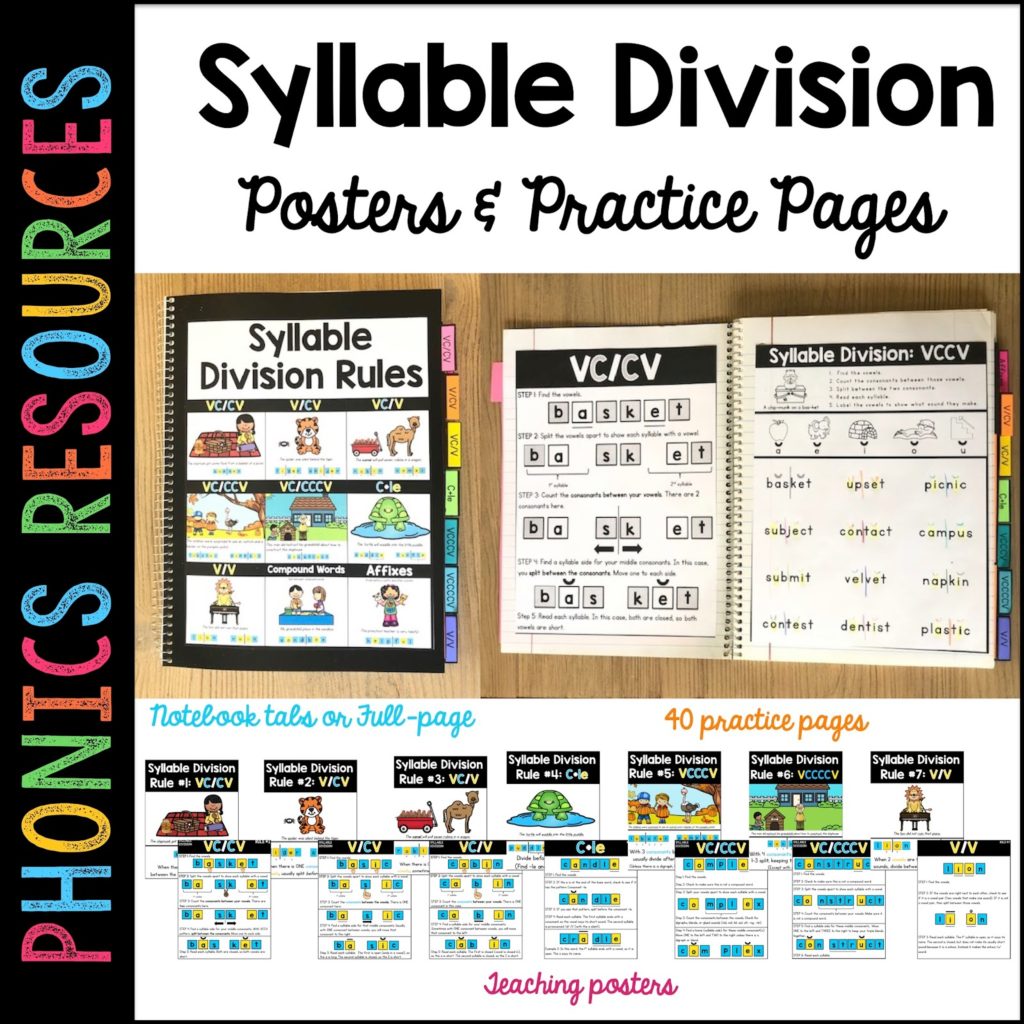
If you’re interested in just these syllable division posters and some practice pages with all syllable types, you can find them HERE.
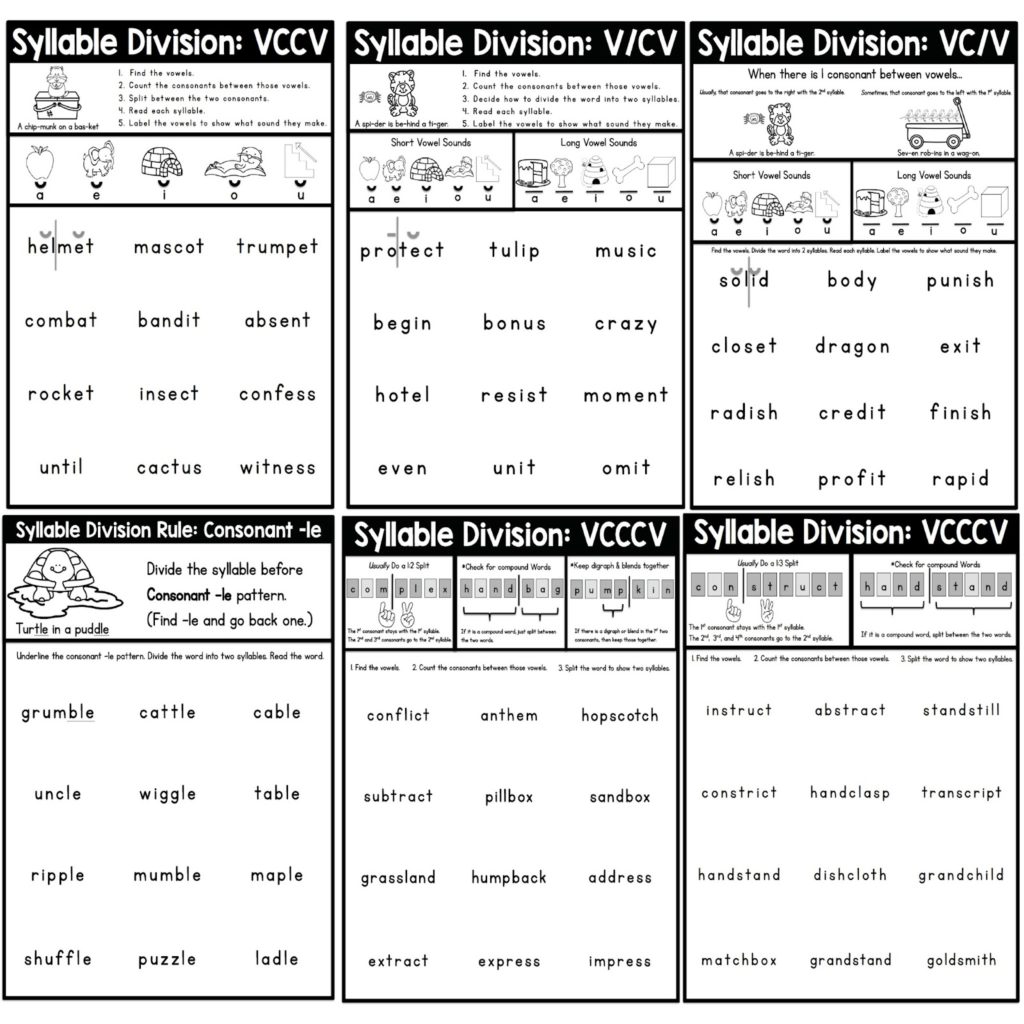
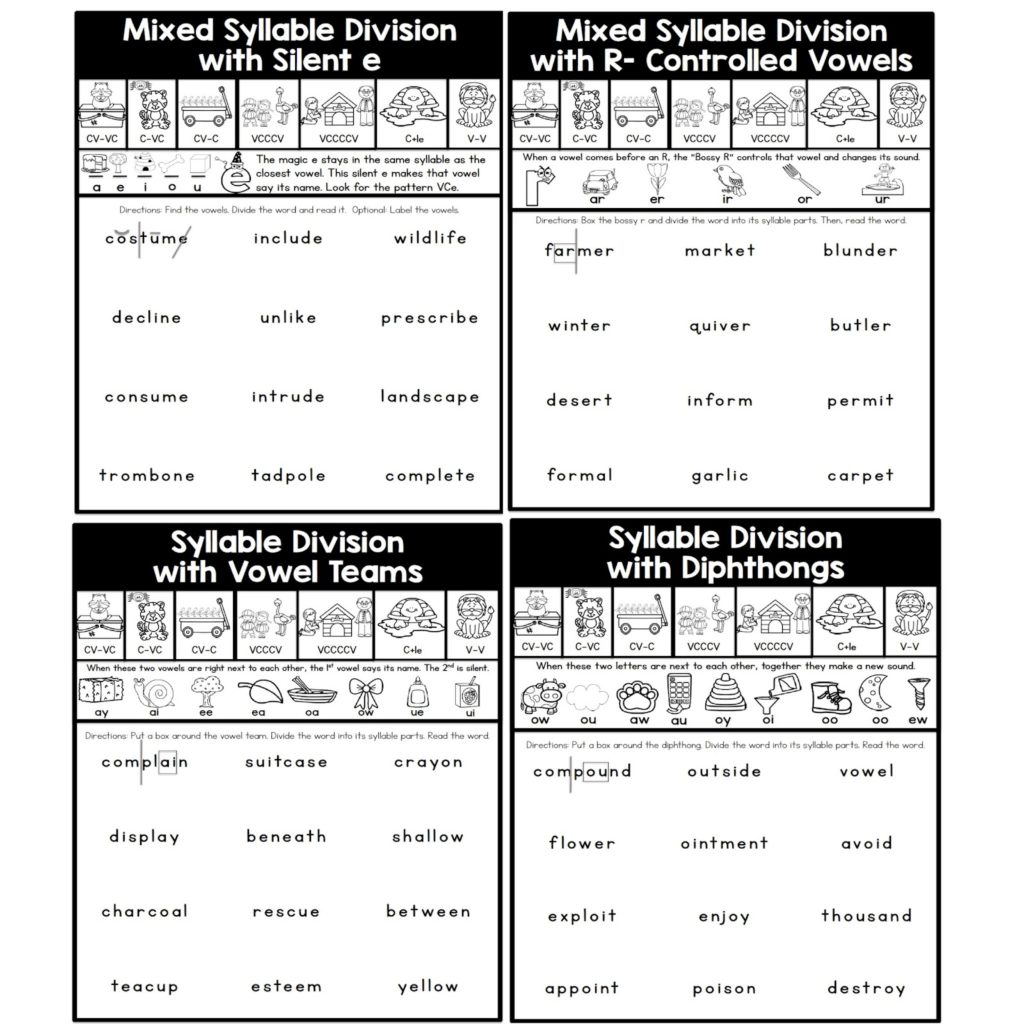
And because I’m so indecisive and have created and recreated so many posters over the years, I included all sets of visuals shown in this post. You can just choose your favorite and print!
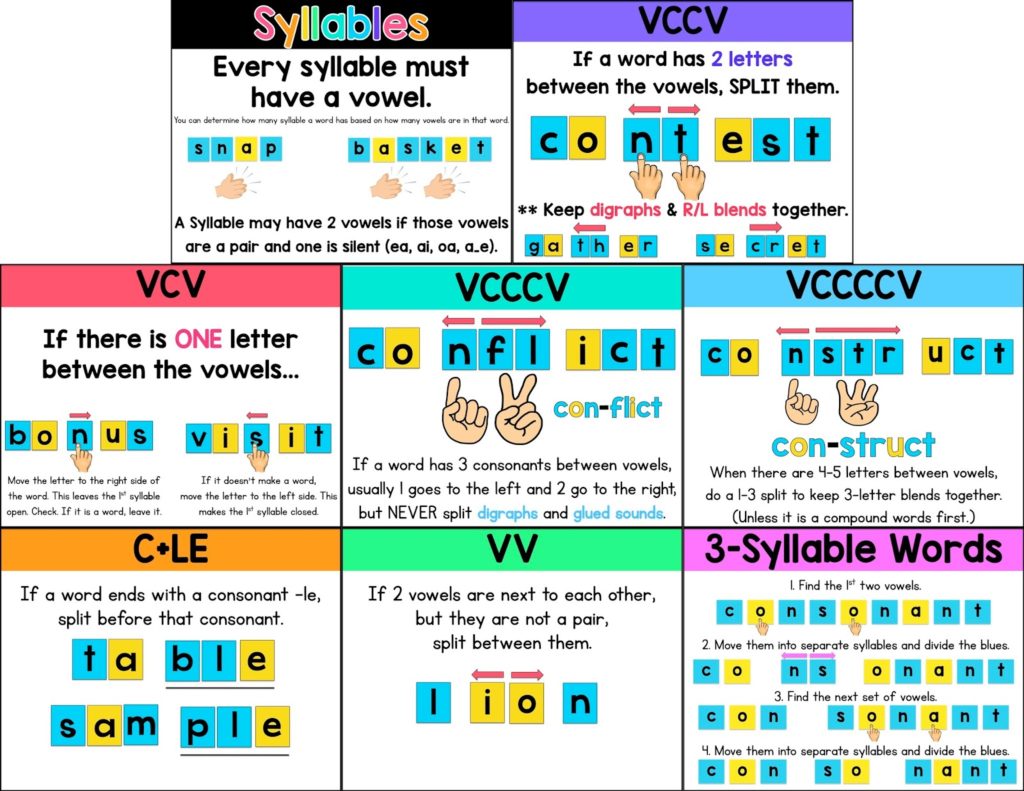
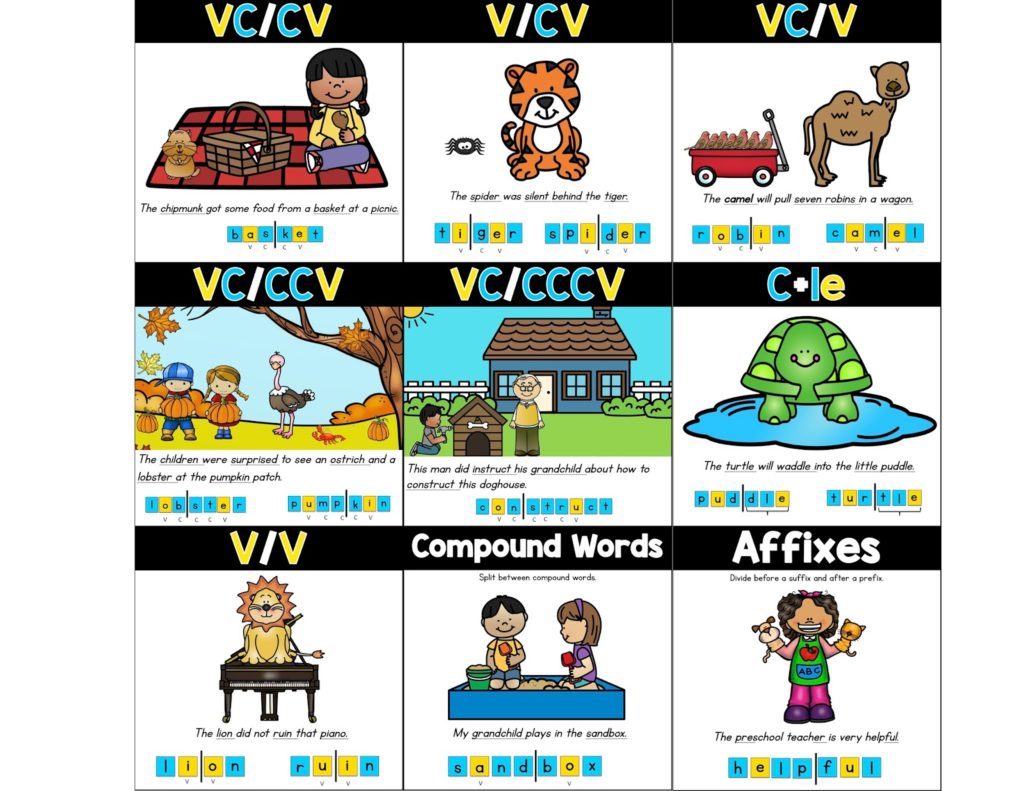
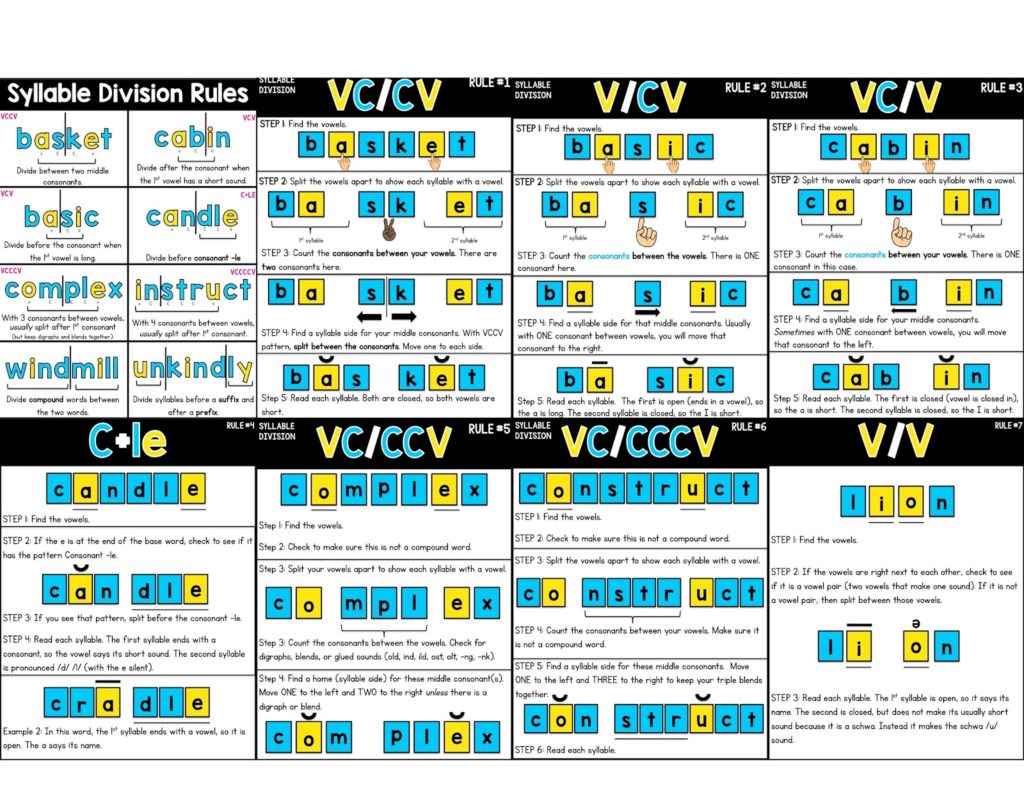
However, if you already own my Syllable Division with Open and Closed Syllables, I also added these posters to that pack! You can find that HERE.
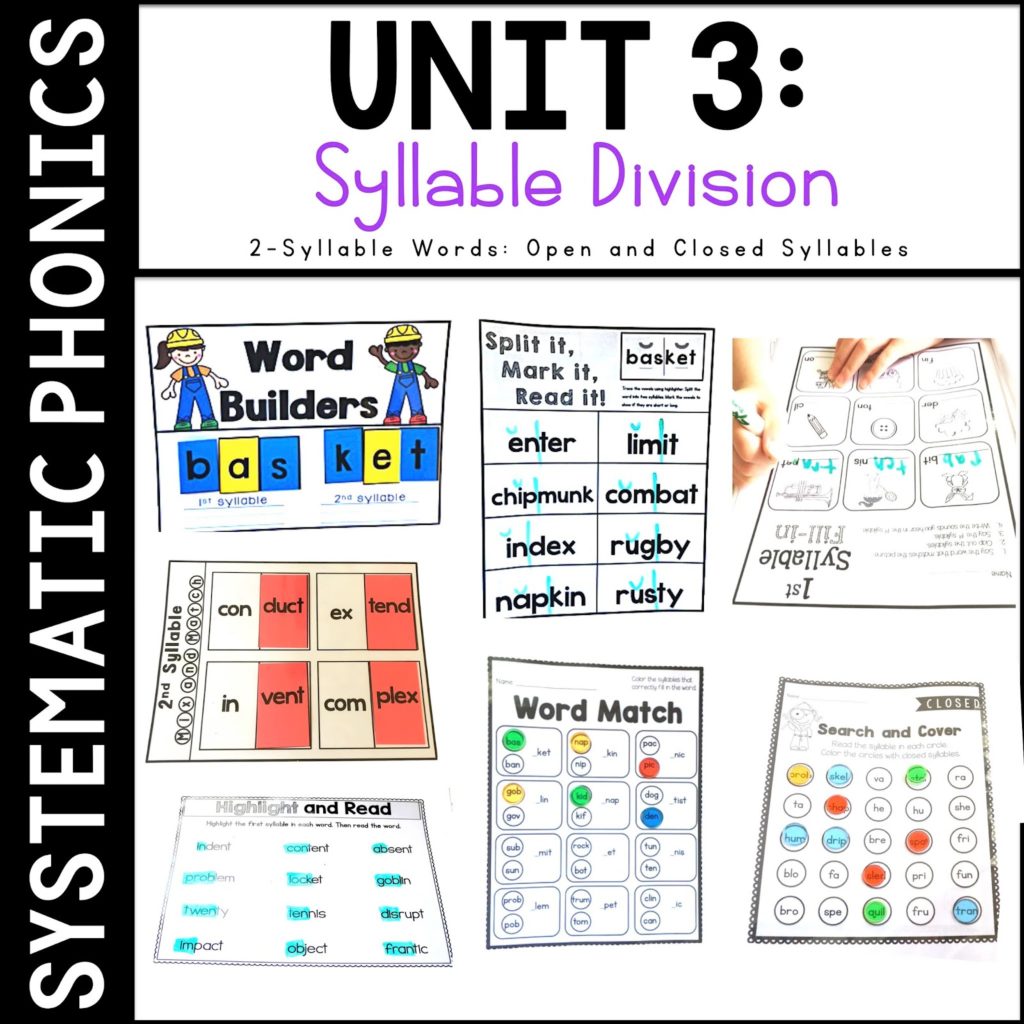
(If you’re wondering what the difference is, this pack above has a lot more practice pages, but just focuses on open and closed syllables because it is part of my systematic units and has detailed lesson plans. The new, smaller pack above that has just the posters and 40 practice pages for all syllable division rules. It includes open and closed syllables then has another section with all the other syllable types. It is not part of the systematic units and does not have the detailed lesson plans.)
More Activities for Practicing Multi-Syllable Words
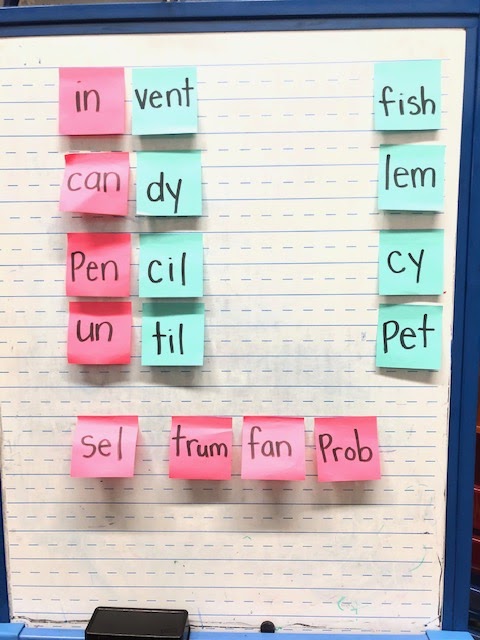
Here are a couple of activities I’ve used to help students practice multisyllable words. These are flexible, low-prep options that reinforce both syllable division generalizations and morphology.
Color-Coded Syllables
Write each syllable of a word in a different color (or use colored cards). Students read the parts separately, then blend them together to make the whole word.
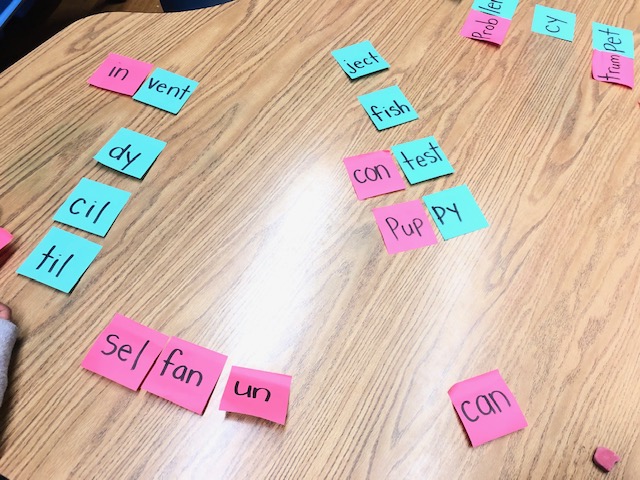
Students read the syllables and matched them to make real words.
What are Syllable Types?
Click HERE to read more about syllable types.