Effective spelling instruction emphasizes the structure of the English language.

I’ll be honest, I made a lot of mistakes with spelling. I gave weekly tests, did a little phonics here and there, and called it good. But I didn’t really understand the role spelling plays in learning to read, and I certainly wasn’t assessing it well.
Like many teachers, I thought English was full of “rule breakers”. I taught “irregular words” as something kids just had to memorize by looking at them over and over. And actually, truth be told, I wasn’t really teaching kids to spell. So, let’s throw out those random spelling lists and learn how we can really help our kids become better spellers!
Does English Make Sense?
I used to think the answer was no. But then I learned English isn’t random at all. It’s actually totally logical and explainable.
These two quotes capture it best:
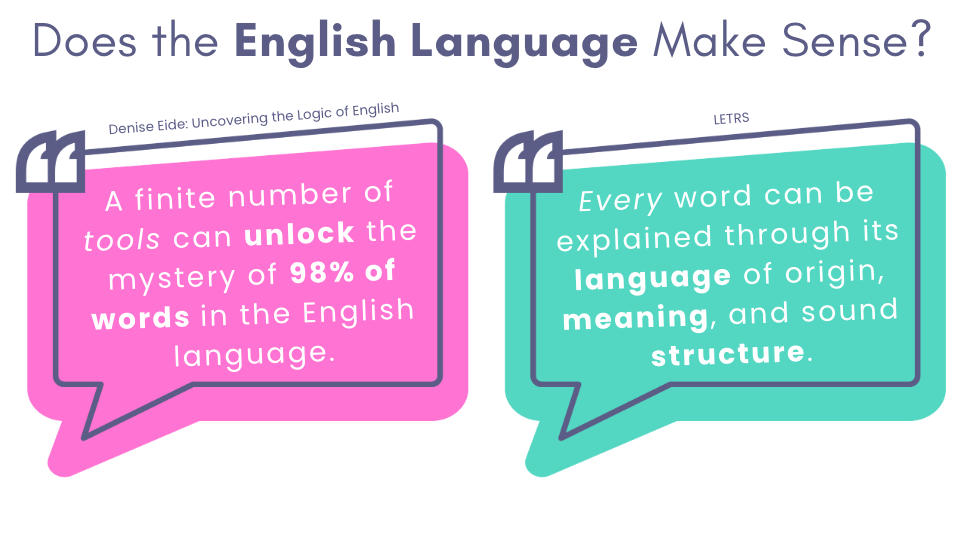
In this post, I’ll unpack what these claims mean and why they matter for teaching spelling and reading.
Is English Really That Irregular?
For years, I thought English spelling was full of “exceptions.” You know why? Because in my mind, spelling was all about “sounding out” words. I didn’t know it at the time, but I was approaching spelling through only one lens (phonology)! There is so much more than that. Once we look at sound, position, syllable patterns, morphemes, and word history, almost every word can be explained!

The takeaway? English isn’t unpredictable at all! Once we understand the system, there are far fewer “exceptions” than we imagine. And students are naturally curious. They want to know why words are spelled the way they are.
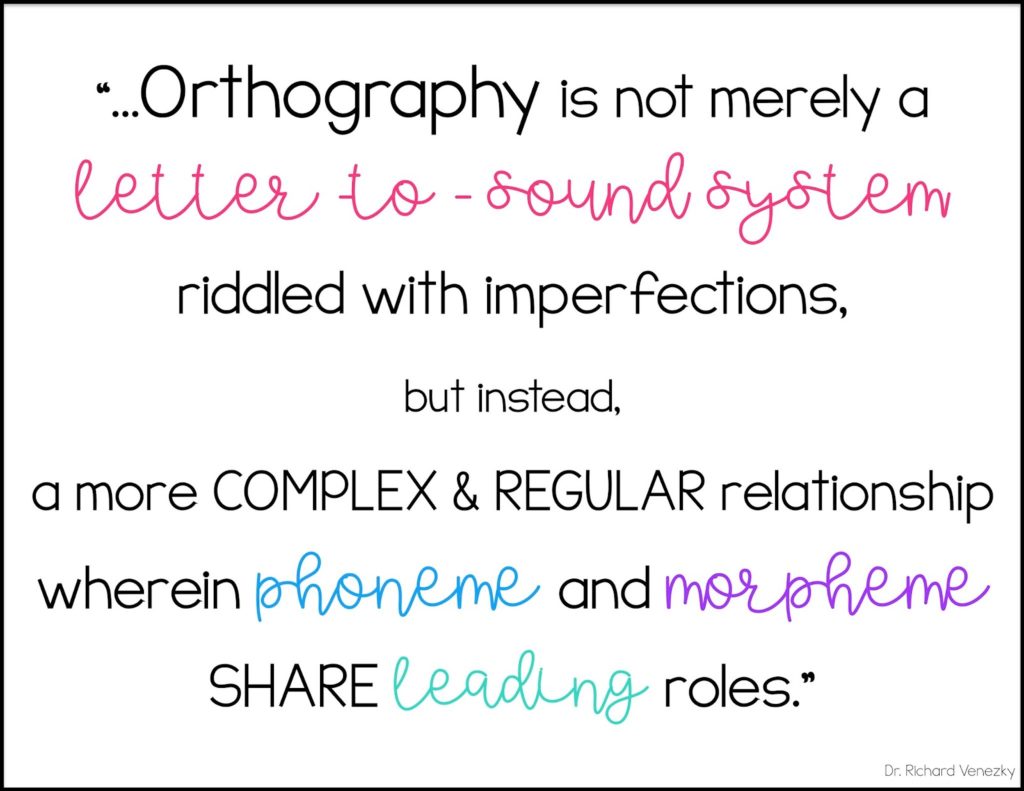
That brings us to the question: So what exactly makes up this system? The answer lies in orthography.
What is Orthography?
Orthography is the system we use to represent spoken language in print. It includes spelling, patterns, and conventions that explain why words are written the way they are.
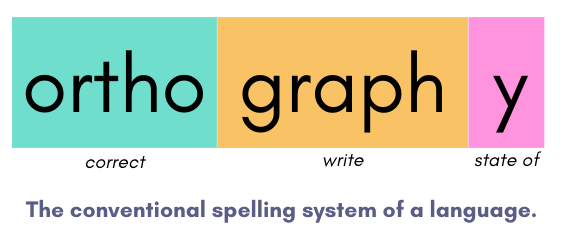
The word orthography itself comes from Greek: ortho (“correct”), graph (“write”), and -y (“state of”). In other words, orthography is literally “the correct way of writing.”
The Four Knowledge Layers of Spelling
To understand why English words are spelled the way they are, we can look at four layers of word knowledge: phonology (sounds), orthography (spelling conventions), morphology (meaningful parts), and etymology (word history). These layers work together to make English logical rather than random. Each layer adds another lens for understanding how words work.
(Note: Sometimes you’ll see it described as three layers, with orthography treated as the umbrella term that covers the others. However you count them, the key idea is that spelling is logical when we look at sound, structure, and history together.)

This visual shows how each layer influences spelling:
- Phonology: The study of the patterns of sounds in a language
- Orthography: The way letters are arranged in words and syllables (patterns, rules, conventions)
- Morphology: The study of the structure of words and how they form meaningful parts like bases, prefixes, and suffixes
- Etymology: The study of word history and origin
Linguistic Units
Before we go further, let’s define some key terms you’ll see throughout this post. These are the core linguistic units that shape spelling. Each one plays a specific role:
- Phonemes: The smallest units of sound (The word “ship” has 3 phonemes: /sh/ /i/ /p/)
- Graphemes: The letters or letter combinations that spell those sounds (sh, i, p)
- Syllables: Units of pronunciation revolving around a vowel sound
- Morphemes: The smallest structural units of meaning, including bases, prefixes, and suffixes
Together, these units explain how English words are structured — and when we teach them explicitly, spelling makes much more sense to students.
Let’s apply these units to one word:

I included letters to show the difference between graphemes and letters. There are 26 letters of hte alphabet, but way more graphemes. Graphemes include those 26 letters plus all the letter combinations that represent sounds (ai, igh, sh, ea, etc.)
As you know, not every word has multiple morphemes or syllables. Every word either has a base or is a base, but not every word has prefixes and suffixes attached to it. I chose this example so I could show all of the units and how they show up with the same word.
The Building Blocks of Spelling
In the classroom, we also need to zoom in on the specific elements that students actually work with as they learn to read and spell. These include the linguistic units like phonemes, graphemes, morphemes, and syllables, as well as orthographic patterns and conventions that guide when certain spellings are used. Together, these are the building blocks of spelling instruction.

Phoneme-Grapheme (Sound–Symbol) Relationships
Phonology is the study of sounds in spoken language. English has about 44 phonemes (speech sounds), which are represented in print by 70–80 common graphemes (letters or letter combinations).
- Phonemes = sounds we hear
- Graphemes = spellings we see
In the early grades, students begin by connecting graphemes (letters and letter combinations) to phonemes (sounds). Kindergarten starts with single letters, then expands in 1st and 2nd grade to multi-letter graphemes like sh, ai, or igh.
Spelling Patterns and Positions
Next, we teach students that spelling often depends on a letter’s position. English isn’t a one-to-one code. That’s why we need to teach students patterns and “rules”. For example, the grapheme ck only occurs at the end of a word after a short vowel (back, pick, duck). These types of patterns help students see that spelling is predictable.
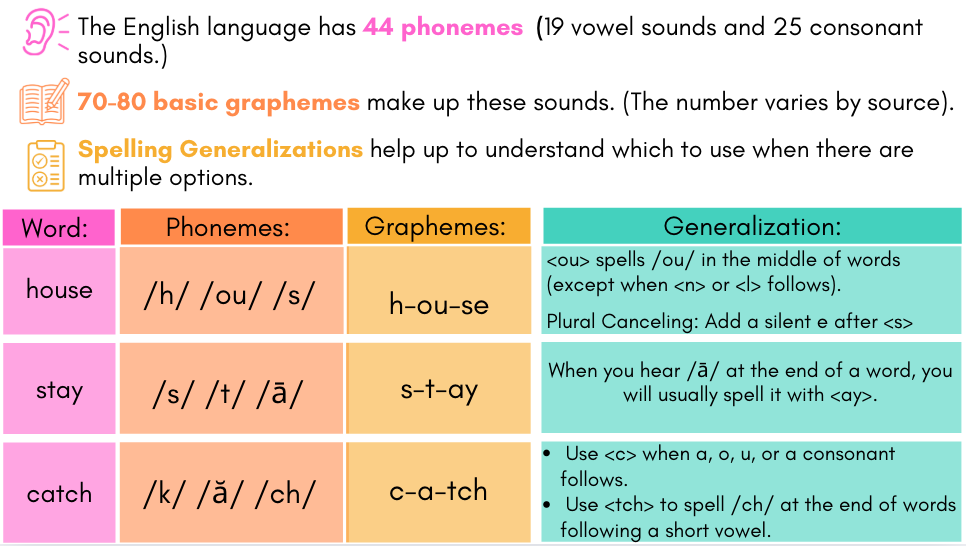
It’s important to note: we are not asking students to memorize rules rigidly. Instead, we teach them to recognize generalizations and patterns that help them make smart spelling choices.
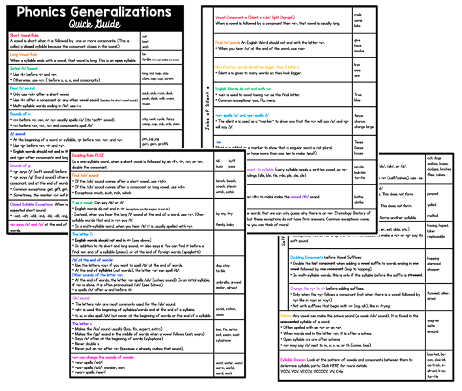
Interested in learning more about the “rules”? Get the FREE quick reference guide to spelling rules. Click HERE.
Syllable Constructions
English spelling also reflects how words are organized into syllables. A syllable is a unit of pronunciation built around a single vowel sound. Understanding syllables gives students another layer of predictability because vowels behave differently depending on the type of syllable.
- Closed syllable: vowel is short (cat, basket).
- Open syllable: vowel is long (me, robot).
- Silent e syllable: the final e makes the vowel long (make, kite).
- Vowel Team: two or more letters represent one vowel sound. (rain, boat)
- R-controlled: vowel sound changes when followed by r. (car, bird)
- Consonant-le: final stable syllable with le. (candle, table)
For spelling, this knowledge can be helpful:
- Students learn that a short vowel is usually spelled with one letter in a closed syllable (pic-nic).
- They see that when a syllable within a word (not at the end of a word) ends with a long vowel sound, it is usually spelled with a single vowel letter (ti-ger).
The goal isn’t to memorize rigid rules. Instead, we want students to see syllable types as patterns that guide spelling decisions. Teaching flexibility is key, especially with vowels.
Click here to read more about syllable types. Click here to read about Syllable Division
Morphemes: The Meaning Units
Morphology is the study of how words are built from the smallest units of meaning, called morphemes. Morphemes include bases, prefixes, and suffixes. Words are built by combining these parts in predictable ways.
Understanding the role that morphemes play in spelling is essential! Why? Because is English is morpho-phonemic: Spellings represent the sounds of words while also preserving their meaning. In other words, our language is built to reflect both sound units and meaning units.

Morphemes are most often spelled consistently, but the pronunciation shifts. This is one huge reason why spelling is so hard! Pronunciation not only varies within word families but also by dialect. Morphemes are the stable units within words. Let’s look at some examples of this:
- The word jumped has a base and a suffix: jump + ed. The -ed can represent three different sounds. Here, it represents /t/, but it can say /d/ or /id/ in other words. No matter what, the spelling is -ed.
- In child and children, the base child has a long i sound but then a short i sound in children. Again, the pronunciation shifted, but the spelling is intact.
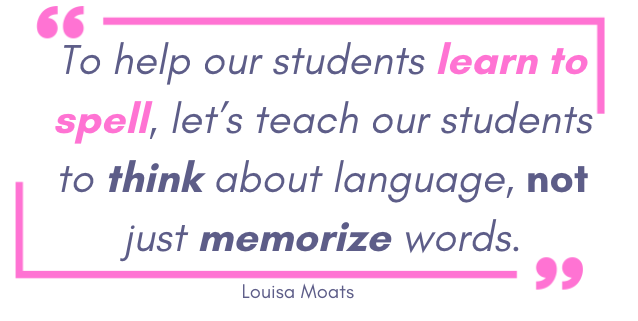
- In sign, the silent g isn’t random, it signals a connection to its relatives’ signal and signature, it’s history (from Latin signum), and its meaning (“mark”).
Once students learn that English spelling preserves meaning as much as sound, the language begins to make sense. Read more about morphology here.
Orthographic Mapping: How Words Become Stored
Orthographic mapping is the mental process that allows students to store written words in long-term memory for instant recognition. Instead of memorizing whole words visually, students connect the sounds (phonemes), spellings (graphemes), and meanings (morphemes) together. Over time, this process builds a mental “sight word” bank.
Researcher Linnea Ehri has shown that orthographic mapping depends on phonemic awareness (the ability to work with sounds in words) and knowledge of grapheme–phoneme correspondences. More recent research highlights that morphemes are also included in this process. That means words aren’t just stored as strings of letters, but as meaningful parts as well.
Orthographic mapping explains why explicit instruction in phonology, orthography, and morphology is so powerful: together, they help students permanently store words for fluent reading and accurate spelling.
Part 2: Application to the Classroom
For many of us, the word “spelling” brings to mind Friday tests with lists of random words. Some kids aced them without trying, others studied all week and still forgot them by Monday. Neither group truly benefited.
But spelling instruction doesn’t have to look like that. In fact, when it’s taught well, spelling is one of the most powerful ways to strengthen both reading and writing.
Spelling instruction should be systematic, explicit, and developmental. That means what we teach and how we teach it changes as students move from early phonics into more advanced word study.
Here is how it can unfold:
1. Build the Foundation with Phonology and Word Mapping
In the earliest stages, instruction focuses on phonology and helping students hear words, break them into individual phonemes (sounds), and map them to graphemes (letters or letter combinations).
- Use word mapping activities to strengthen sound–symbol connections.
- Follow a scope and sequence to guide which graphemes to introduce and when.
- Begin introducing syllable types (closed, open, silent e) alongside phoneme–grapheme instruction so students see how syllable patterns affect vowel sounds.
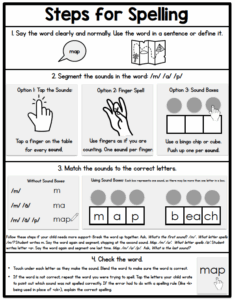
Follow these steps for word mapping:
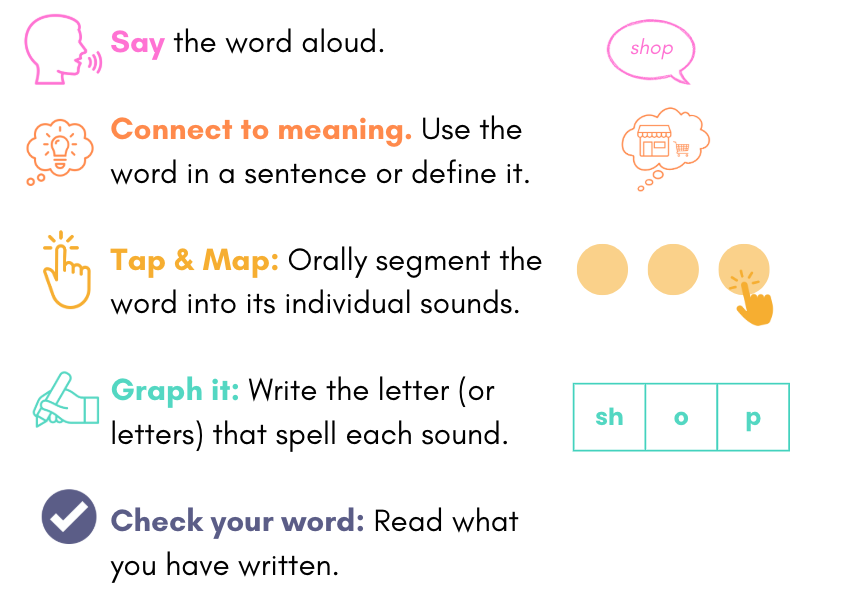
Click here to download free spelling steps posters.
2: Teach Orthographic Patterns and Conventions
Once students have a solid foundation in sound–symbol knowledge, begin teaching them how position and patterns affect spelling choices.
- Examples: ck comes after a short vowel at the end of a word (duck), ou vs. ow depends on position.
- Emphasize that these are generalizations, not rigid rules. Students learn to apply them flexibly.
- Continue weaving in syllable types to reinforce vowel behavior and syllable structure.
Again, your scope and sequence should guide when to teach these.
3: Introduce Morphology from the Start
Morphology isn’t something to “save for later”. You can start in kindergarten!
- Teach the concept of a base word.
- Introduce high-frequency suffixes and prefixes right away, starting with -s after teaching CVC words.
- Add other common affixes (like -ed, -ing, un-, re-) gradually, always connecting them back to meaning.
- Look at word families (In the early grades: play, plays, playing, player, replay, unplayed; 2nd and beyond: define, finite, definite, definitely, finish, final, definition)
- Teach Suffixing conventions. (Learn more in this post.)
Want to learn more about how to teach morphology and spelling? I have a whole course about it! Learn more here.
4: Expand into Multisyllabic Words
As students begin writing longer words, spelling instruction should include syllable knowledge and advanced morphology.
- Teach students that every syllable has one vowel sound. This helps them hear and count the syllables in a word they want to spell.
- Use syllable types to guide vowel spelling choices. For example, the word rabbit has two closed syllables (rab-bit). The double consonants between the vowels signal that the vowel is short. This predictability supports accurate spelling.
- Check for familiar prefixes and suffixes.
- Study common Latin and Greek bases.
Assessing Spelling
Spelling assessments should measure understanding, not memorization. Instead of a list of unrelated words, choose words that reflect the phonics and morphology concepts you’ve been teaching.
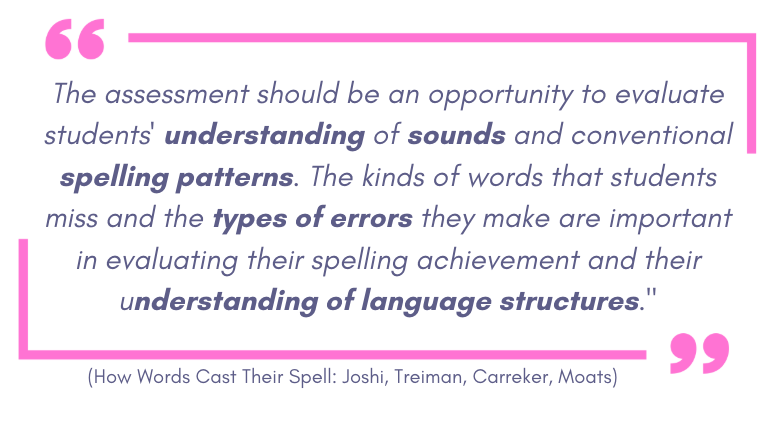
Errors show you whether a student understands the structure and patterns, and where instruction should go next.
A helpful tool is a spelling inventory. These assessments include a set of words designed to reveal students’ developmental stage. Instead of focusing on right vs. wrong, you analyze which patterns students are using correctly and which they aren’t yet. This helps you group students for instruction and track progress over time.
Types of Spelling Errors
Looking closely at the kinds of errors students make is one of the most powerful ways to guide instruction. Some common types include:
- Phonological errors: The student struggles to represent all the sounds.
- Example: sip for slip
- Orthographic pattern errors: The student represents the sounds but doesn’t yet know the correct spelling pattern.
- Example: bake spelled as baik or bak for back.
- Morphological errors: The student doesn’t show an understanding of morpheme structures.
- Example: jumpt instead of jumped or hoped for hopped
By categorizing errors, we can pinpoint where a student needs more work and then target instruction accordingly.
What About Spelling Tests?
Traditional spelling tests (random lists of words students memorize for Friday) don’t tell us much about what kids actually know. Some students can cram and ace the test but then misspell the same words in their writing the next day. Others study hard but can’t hold the words in memory without understanding the patterns. Neither approach builds lasting word knowledge
The “test” should be a diagnostic tool, not just a grade. The goal isn’t for students to cram a list of random words but to show what they’ve learned about a specific pattern.
Instead of sending home a list to memorize, choose a grapheme or pattern focus (like ai/ay for long a). Throughout the week, give students opportunities to read and spell words that fit this focus in class.
At the end of the cycle, assess their spelling, similar to a traditional test where you call out words and students write them, but with a key difference: the words are chosen because they match the concept they studied, not because they were on a memorized list.
To wrap up:
- Choose words that reflect the phonics or morphology concepts you’ve taught.
- Use the results diagnostically. Study the errors to see what students understand and what they still need to practice.
- Include a few affixed forms that you have already taught. (For example, by the time my students are working on consonant cluster/blends, they have learned suffixes -s and -es, so I’ll include a couple words with those suffixes that also have blends, like jumps or flashes.
Developmental Stages of Spelling
This post is already too long, but I can’t do a spelling post without mentioning this! Spelling develops in predictable stages. Richard Gentry originally called these stages, and more recently (in Brain Words by Gentry & Ouellette), they’ve been updated to phases.
The stages are:

It’s also helpful to know what’s typical at each stage. Knowing the “norm” allows us to recognize when a student may just need more practice versus when their spelling errors signal a possible learning difficulty, like dyslexia, that requires targeted intervention.
What About Students With Dyslexia?
Dyslexia is a language-based learning disability. It is neurobiological in origin, genetic, and surprisingly common, affecting about 1 in 5 students. Students with dyslexia often have average to above-average intelligence and many strengths (like creativity, spatial reasoning, or big-picture thinking), but they struggle with decoding (reading), encoding (spelling), word recognition, and fluency.
Early Signs in Spelling
You can often spot early signs of dyslexia in a student’s spelling. Even before formal reading instruction begins.
- Students with dyslexia may show unusual invented spellings.
- As spelling develops, they often struggle to segment sounds or match them to graphemes consistently.
- Their misspellings may look very different from those of typically developing spellers, signaling phonological processing deficits.
Why Spelling Instruction Matters Even More
Because students with dyslexia struggle to automatically connect sounds and symbols, they need explicit, systematic instruction in how English spelling really works. Memorizing word lists won’t stick! They need to understand the structure of our language:
- Phoneme–grapheme correspondences
- Spelling patterns and syllable constructions
- Morphemes (prefixes, suffixes, bases)
- Word histories (etymology)
When spelling instruction is taught this way, it becomes an additional tool for building both reading and writing.
Research shows that with the right instruction, we can actually strengthen the brain circuits involved in reading and spelling for students with dyslexia. (One article here)
Because students with dyslexia struggle with phonemic blending, segmenting, and automatic word recognition (recognizing a word “on sight”), spelling instruction is even more important for them! Traditional spelling tests with the “memorize-these-words-for-a-test” focus are very challenging for them and not at all beneficial. They need to understand the structure of our language more than anyone, as an additional tool in their reading tool belts.
That means instruction should be:
- Explicit and systematic — step by step, building from simple to complex.
- Multisensory — involving seeing, saying, hearing, and writing.
- Diagnostic — using errors as data to guide next steps.
Accommodations are also important. (Click here, here and here for ideas.) Even with strong intervention, spelling may remain difficult for a long time. Typically, reading improves first, while spelling takes more time to catch up.
The takeaway: Students with dyslexia need spelling instruction more than anyone. When we teach the structure of English, we give them the tools to unlock reading and writing, instead of leaving them to struggle with memorization that won’t last.
Free Downloads from this post:
Spelling steps posters (Primary grades- single syllable words)
Related Resources:
Click here for word lists (organized by phonics or morphology skill)
Click here for Systematic Phonics Resources.
Click here for Morphology Resources
Click here for Spelling Resources
References:
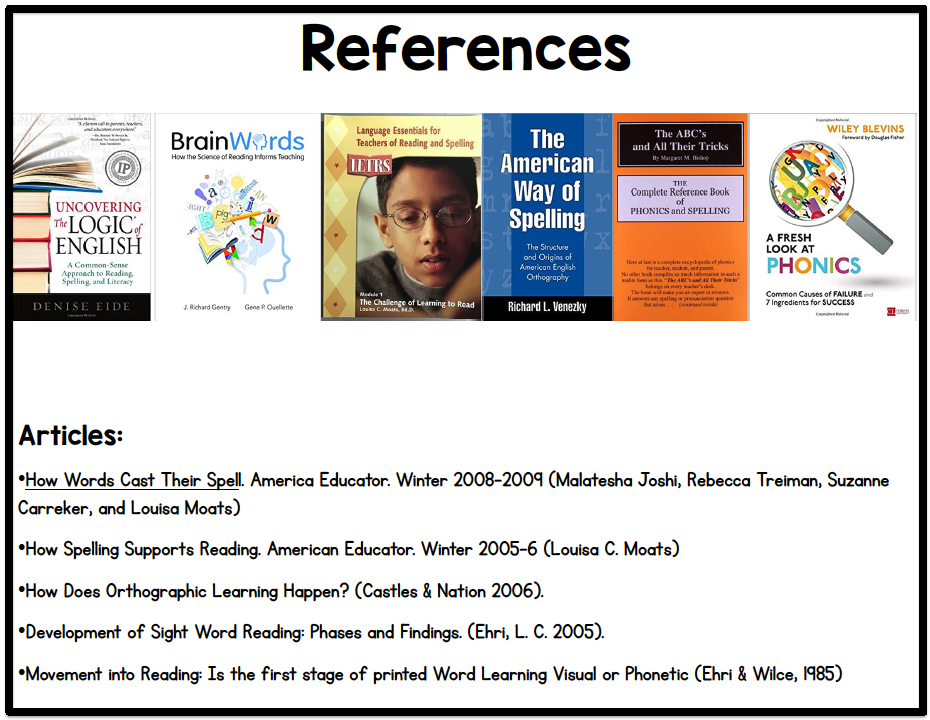
I highly recommend looking into these books to learn more! If you want to learn more about the rules of English, Uncovering the Logic of English is a great resource.