Phrasing is a foundational part of reading fluency. Teaching students to read in phrases strengthens prosody, decoding momentum, and comprehension by helping the brain group words into meaningful ideas. Teaching students to identify and read in phrases builds the habits fluent readers use naturally.
What is Reading Fluency
Fluent readers do more than read quickly. They read in meaningful phrases that help the sentence flow and make sense. Fluency is the result of several skills working together: reading with accuracy, pacing, phrasing, and expression, so meaning comes through clearly. It’s not just speed, and it’s not just sounding smooth. Real fluency means a reader can decode words and deliver the message in a way that supports understanding. That’s where phrasing comes in.
What is Phrased Reading
Phrasing is the way readers group words together in a meaningful way. Phrasing plays a big role in reading fluency because it helps students learn to group words in meaningful chunks. Fluent readers do this naturally. Their brains automatically organize words into meaningful chunks, and their voices adjust to match the meaning of the sentence. But for many developing readers, phrasing isn’t automatic yet. They need explicit instruction and supported practice to learn how words work together inside a sentence. This post will illustrate just how versatile this one strategy can be.

Why is Phrased Reading Important
Phrasing supports more than just fluency. It also supports comprehension. And actually, the opposite is true because when we are phrasing correctly, we are showing that we comprehend at the sentence level. Phrasing helps the brain hold words together long enough to connect ideas, instead of losing meaning halfway through a sentence.
What Phrasing Sounds Like
Let’s look at a simple sentence to see how phrasing changes the way meaning comes through.
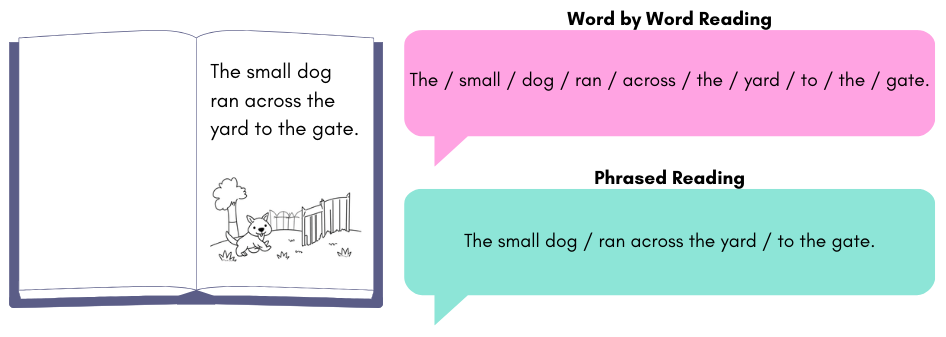
When reading word by word, even if the student reads each word accurately and automatically, the meaning becomes choppy. The sentence starts to sound like a list of words instead of a connected idea.
The phrased reading shows how the words are grouped in a way that reflects how we naturally speak and think. Each phrase carries one part of the idea, making the sentence smoother and easier to understand.
It’s important to understand that accurate word reading is not the same as fluent reading.
Fluency requires readers to group words meaningfully so they can hold the idea together as they read, not just move from one word to the next.
When students phrase correctly, they’re showing comprehension at the sentence level. That’s why phrasing isn’t just about how reading sounds. It’s about how meaning is constructed in the reader’s mind.
Let’s look at another example of a sentence that an older student may encounter:
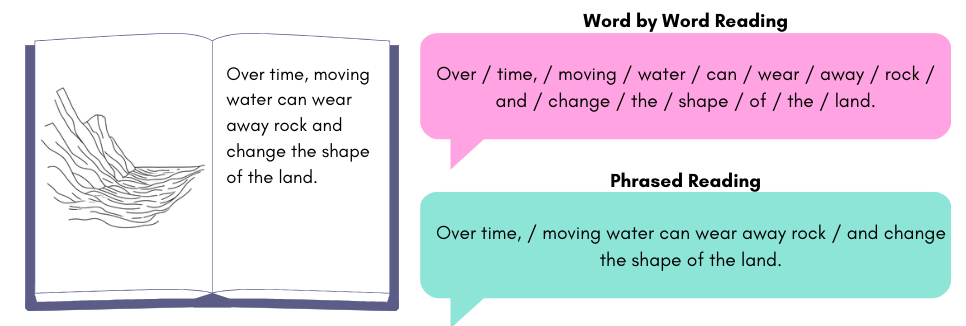
Grouping the sentence into meaningful phrases helps the reader understand how the ideas connect. Simply taking time to think about phrases within a sentence can improve comprehension.
How to Teach Phrased Reading
The goal of phrasing instruction is not necessarily to improve speed. It’s helping students group words into meaningful chunks so they can hold ideas together while reading and read in a smoother, more natural way. This requires modeling, listening, and purposeful rereading.
One of the most effective ways to teach phrasing is by making phrase boundaries visible at first, then gradually removing that support as students internalize how fluent reading sounds and feels. That’s where strategies like scooping phrases and phrase-cued reading come in.
Before introducing scooping or phrase marks, I explicitly teach students what a phrase is.
Teaching Students What a Phrase Is
When I introduce phrasing, I explain that some words go together in our minds because they tell one part of the message in a sentence. I start with more obvious phrases. These might be words that tell who the sentence is about, what is happening, or where or when something is happening.
I start by having students read phrases on their own , separate from sentences at first. This helps them start to understand the concept of a phrase. If you’re working with younger students, the phrases can tie into your phonics lessons by making them decodable.
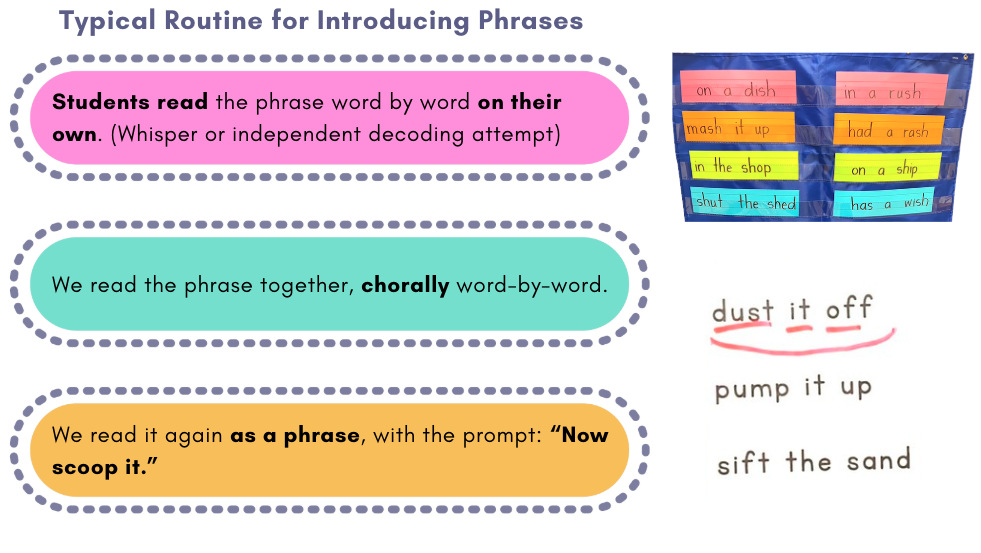
You can do this simply by writing phrases on the board, or you can use sentence strips. In the top picture, we are working on digraphs, and the phrases reflect that. On the bottom picture, we are working on consonant clusters. For the bottom picture, each student has a page of phrases. Some kids liked the physical act of underlining each word as they said each word: dust / it / off. Then, when we reread it as a phrase, they scooped it.
This routine gives students multiple purposeful rereads. They’re not rereading because they made a mistake or just for the sake of rereading. They’re rereading because they have a new mission each time.
Introducing Phrasing: What This Looks Like in Practice
I’ve come to learn that phrasing instruction should look different depending on what a student needs. The same strategy can serve different purposes at different stages of reading development.
Below, I’ll walk through how I use phrasing and scooping with different types of readers, and what the instructional focus looks like at each stage.
Before I do that, I want to show the two main ways that you can show phrase boundaries with students:
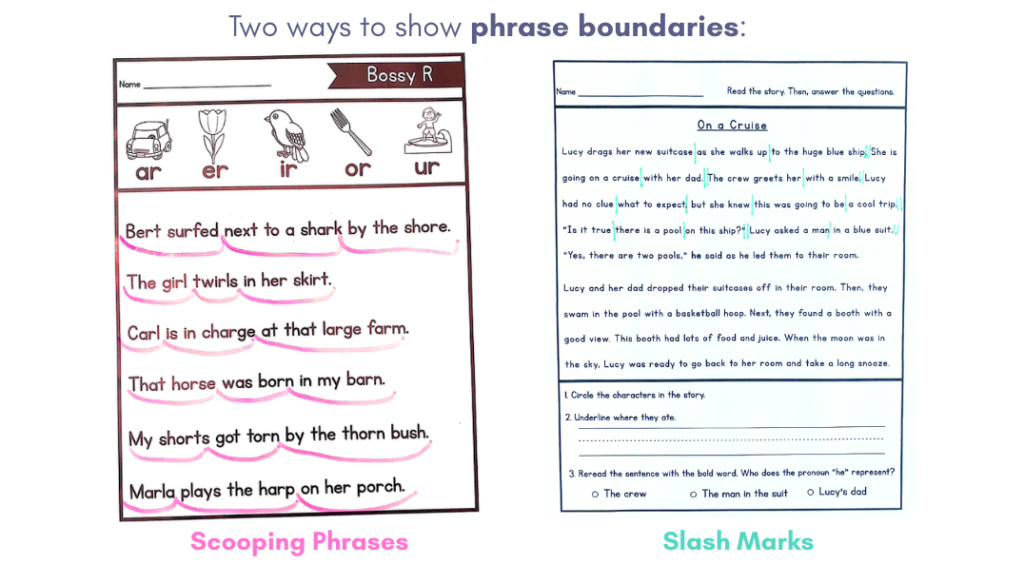
I use scoops with younger students, then transition to uing slash marks for older students.
Phrasing for Beginning or Struggling Readers
Some students are still decoding most of the words in a sentence. They may read accurately, but the process is slow and effortful. By the time they reach the end of a sentence, they’ve often lost track of what they just read, not because they don’t understand, but because decoding is using most of their mental energy.
For these readers, phrasing isn’t about reading faster or sounding expressive yet. It’s about reading more successfully with less strain, and holding onto meaning long enough to connect the idea instead of just the next word.
At this stage, I use phrasing as a decoding bridge. I draw in scoops to break the sentence into manageable parts, giving students a clear stopping point. Students read to the end of each scoop, then immediately reread the words in that phrase while it’s still fresh in their working memory.
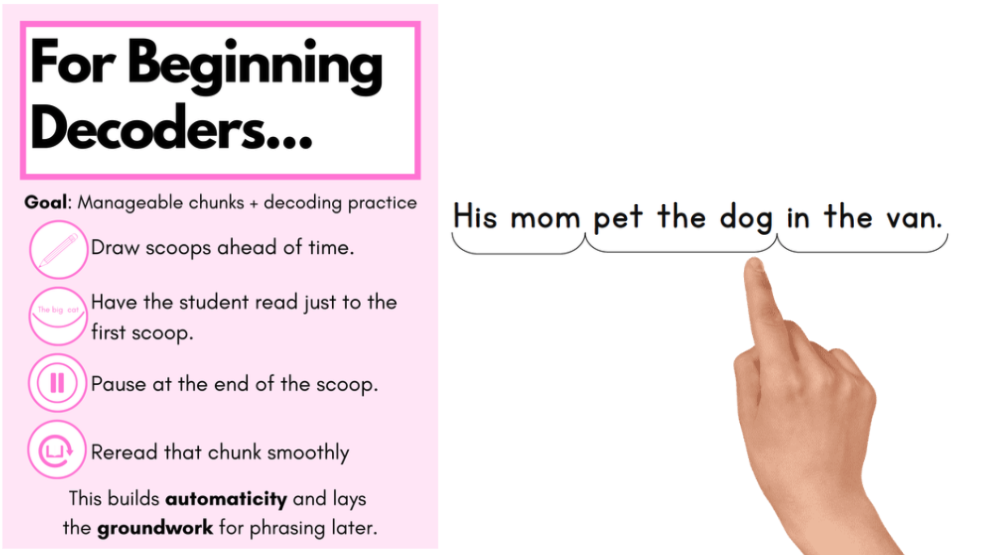
This allows students to:
- Regain momentum after decoding
- Revisit words they just worked hard to read
- Hold one idea at a time instead of juggling the whole sentence
Instead of reading an entire sentence and losing meaning along the way, students decode one idea-chunk at a time, rereading each phrase before moving on. Over time, this repeated, purposeful rereading supports accuracy, early automaticity, and a growing sense of how words group together to make meaning.
At this level, scoops are about supporting decoding and reducing cognitive load while laying the groundwork for fluency later.
Phrased Reading for Word-by-Word Readers with Solid Recognition
Many students reach a point where they can read most words accurately and automatically, yet their reading still sounds flat or robotic. They aren’t struggling to read the words, but they’re reading one word at a time, without grouping words into meaningful phrases.
For these readers, the challenge isn’t decoding. It’s learning how to bring the sentence to life by reading in a way that reflects how language works. This is where phrasing shifts from a decoding support to a prosody scaffold.
At this stage, I continue using scoops, but for a different purpose. Instead of helping students get through the words, scoops help them learn how words belong together inside a sentence. I model the difference between reading word by word and reading in phrases, often thinking aloud as I decide where phrases belong.
I’ll name the role of a phrase when it helps or is applicable (who the sentence is about, what action is happening, or where or when something is happening). I also model nonexamples, showing that while there can be more than one correct way to phrase a sentence, not every grouping makes sense.
After modeling, students move into guided practice. We test different ways to scoop a sentence and talk about which groupings best carry the meaning. This discussion is an important part of the work. It encourages students to reread, attend to every word, and make decisions based on meaning.
Once students begin identifying phrase boundaries more independently, they reread the full sentence, pausing briefly between phrases. This repeated, purposeful rereading builds fluency, supports expression, and helps students internalize how fluent reading sounds and feels.
At this level, scoops act like training wheels for fluency. They make the invisible structure of a sentence visible for a time, until students no longer need the markings and can read smoothly by grouping words naturally on their own.
One way this can look in practice is through a short, purposeful rereading routine like the one shown below:
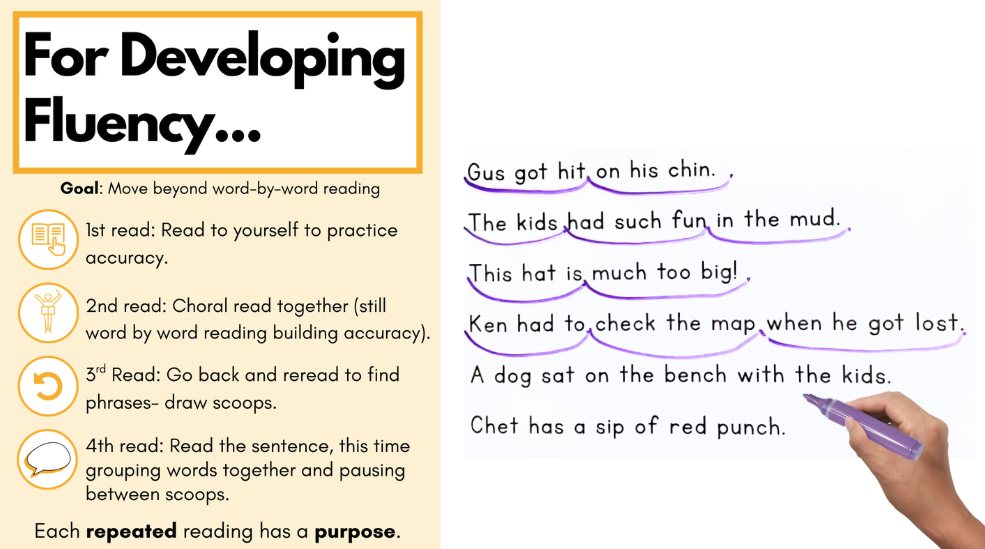
Phrasing for Fluent Readers Who Lose Meaning in Longer Sentences
Some students read with solid accuracy, an appropriate rate, and even some expression, but still struggle to fully understand or retain what they read. They sound fluent, yet comprehension breaks down, especially when sentences become longer or more complex.
For these readers, phrasing serves a different purpose. Phrasing becomes a comprehension support. It can be a way to help students organize ideas and keep meaning active as they read.
This often comes up in content-area reading, where sentences are dense and information-packed. When students read these sentences word by word, or rush through them without grouping ideas, it’s easy to lose track of how ideas connect. Phrasing helps slow the reading just enough to make sense of relationships between ideas.
At this stage, I usually shift from scooping to using slash marks to show meaningful idea clusters. The main reason for this shift is space! When the text gets longer, you don’t really have room for full-on scoops, so using slash marks (/) to mark phrase boundaries makes more sense.
We start by reading a sentence once for meaning. Then, we reread the sentence and work together to decide how the sentence can be broken up into smaller meaning chunks.
After we’ve identified phrase boundaries, students reread the sentence, pausing briefly between phrases. This slows reading just enough to support comprehension without breaking the flow.
Finally, we talk about why the words were grouped together. Discussing the role of each phrase helps students see how ideas connect and builds awareness of sentence structure, specially in longer, content-area sentences.
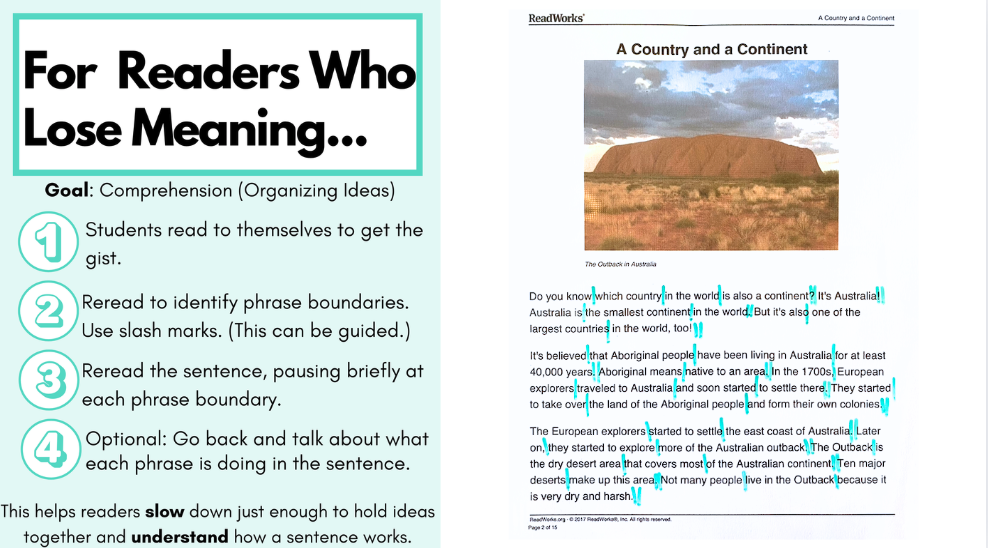
Reading in phrases helps students:
- Hold meaning in working memory long enough to connect ideas
- Reduce cognitive load so long sentences feel more manageable
- Notice how details attach to a main idea instead of getting lost mid-sentence
Phrase-Cued Reading
In some cases, students benefit from seeing phrase boundaries already marked. This is where phrase-cued reading comes in.
With phrase-cued reading, the teacher adds slash marks ahead of time to show how a fluent reader groups words into meaningful phrases. (Before you make your copies for the class, use a pen to make the slash marks to show the phrase boundaries. This is also a great way to differentiate. Students get the same text, but some may get the copy with the slash marks.)
I often use phrase-cued reading when sentences are especially long or complex, or when students are still learning how to identify phrase boundaries on their own. Students read the sentence using the slashes, listening for how the phrasing supports meaning.
Here is an example of a 3rd/4th-grade text:
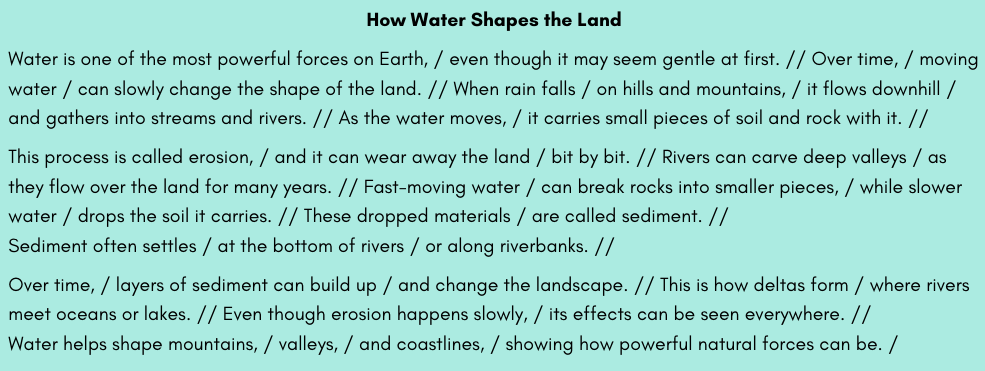
Over time, the goal is to remove this scaffold. As students become more confident, we shift back to having them create phrase boundaries themselves. The slashes are not the endpoint. They’re a temporary support to help students internalize how fluent, meaningful reading sounds and feels.
This approach isn’t new! Phrase-cued reading dates back to fluency research by Jay Samuels and has been further developed by Timothy Rasinski.They highlight how cueing phrase boundaries can help readers move beyond word-by-word reading and better hold meaning while reading. They both emphasize that prosody reflects understanding, not speed.
Additional Ways to Help Students Hear and Find Phrases
Across all stages of reading development, students benefit from opportunities to listen for phrases, test groupings, and notice how phrasing affects meaning. These strategies aren’t tied to one specific type of reader. They’re flexible tools you can use to build phrasing awareness over time.
Listening First: Teacher Reads, Students Scoop
One of the simplest ways to help students understand phrasing is to remove the pressure to read at first. I’ll read a sentence aloud, pausing naturally between phrases, while students just listen. Then, I read it again and ask students to draw scoops under the words (or use the slash marks) to match what they heard.
This allows students to attend to how language sounds when it’s read fluently. It also creates a purposeful reread, since students have to revisit the sentence to add their scoops.
Using Sentence Strips to Physically Group Words
Another powerful way to make phrasing concrete is by using sentence strips. I’ll write a sentence, cut it into individual words, and lay them out so students can see each word clearly. Together, we physically move the words to group them into phrases.
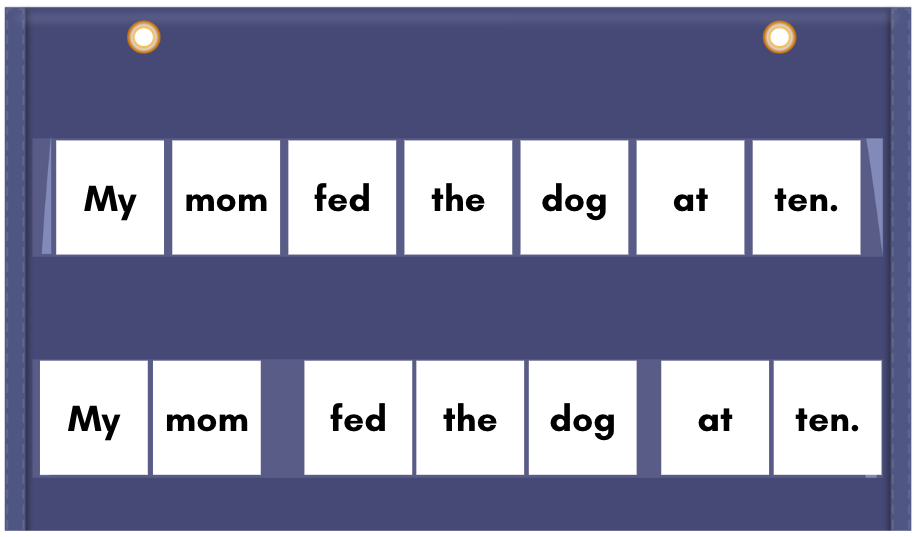
This hands-on approach slows students down and makes the structure of the sentence visible. It’s especially helpful for students who need to see how words belong together, and it naturally leads to discussion about why certain groupings make sense. I also mentioned this in my post about Sentence Scramblers. If you’re looking for decodable sentences to use for this activity, check out this post!
Showing Nonexamples to Clarify Meaning
Sometimes the fastest way to teach phrasing is to show what doesn’t work. I’ll model an awkward or incorrect grouping and ask students whether it sounded right and why. Hearing phrasing that breaks meaning helps students refine their sense of what phrases should do: carry one part of the idea clearly.
Nonexamples also reinforce an important message: phrasing isn’t random. It’s flexible, but it’s guided by meaning.
Exploring Different Ways to Phrase the Same Sentence
Once students have some experience with phrasing, we’ll try grouping the same sentence in more than one meaningful way. We read each version aloud and listen for differences in emphasis or flow.
Each of these routines supports the same big idea: fluent readers don’t just read words. They read ideas. By giving students repeated opportunities to hear, test, and discuss phrasing, we help them internalize how language works and apply that understanding independently when they read.
Resources
I have created so many resources that can be used to work on phrasing.
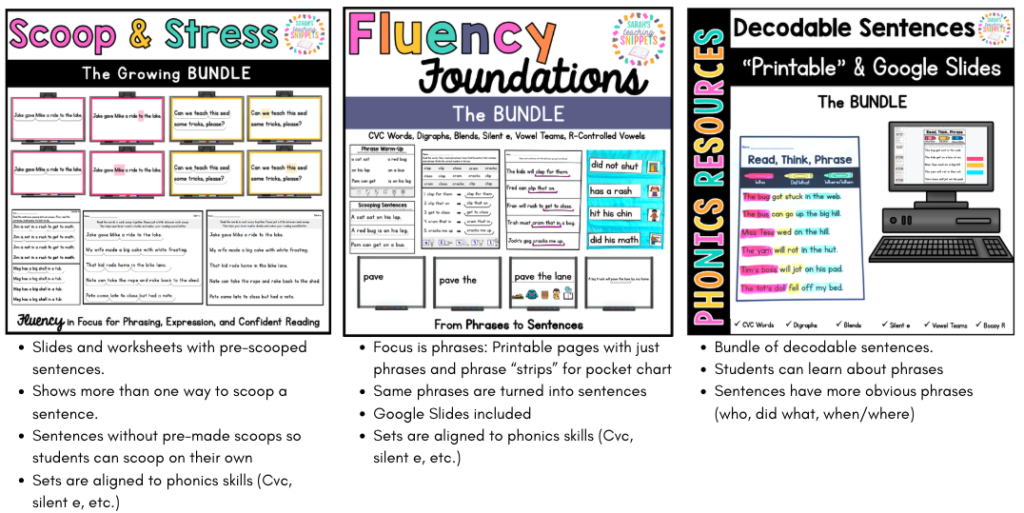
Click here for Scoop and Stress: (This is the link to the bundle. You can scroll down to see the individual sets for each phonics skill.)
Click here for Fluency Foundations: (This is the link to the bundle. You can scroll down to see the individual sets for each phonics skill.)
Click here for Decodable Sentences: (This is the link to the bundle. You can scroll down to see the individual sets for each phonics skill.)
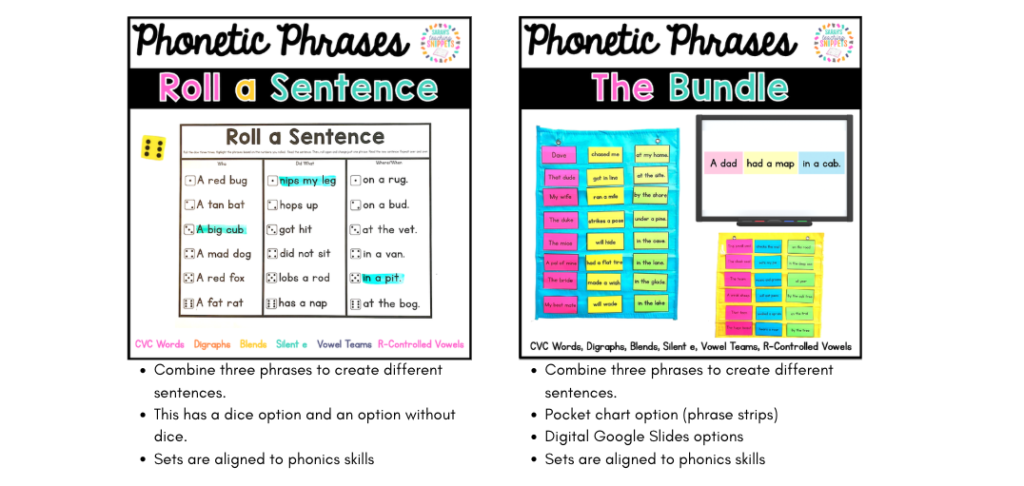
Click here for Roll a Sentence
Click here for Phrase Sentence Building (This is the link to the bundle. You can scroll down to see the individual sets for each phonics skill.)