When you think of teaching phonics, handwriting might not be the first thing that comes to mind. But did you know that the simple act of writing letters and graphemes by hand actually supports phonics instruction and plays a powerful role in helping kids become fluent readers and spellers?
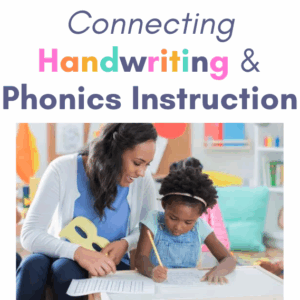
To be honest, I hadn’t really thought much about integrating handwriting with phonics — until a former colleague (and friend) called me up one day to chat about it. She asked if I had any handwriting resources that went beyond just the alphabet. I was intrigued! We had a great conversation about how teachers could align handwriting practice with the graphemes they’re teaching in phonics.
After that call, I had to dig deeper. I knew handwriting was important. I’ve seen firsthand the challenges students face when they struggle with letter formation or poor handwriting skills. But I had always thought about it at the letter level, not the grapheme level. It makes so much sense now: if we’re teaching students sound-symbol relationships, why not give them handwriting practice that matches the exact sounds and spelling patterns they’re learning?
Handwriting Activates the Reading Brain
Research shows that handwriting activates neural pathways that are directly linked to reading and spelling. When children form letters by hand they engage the parts of the brain responsible for connecting what they see (the letter shape) with what they hear (the phoneme) and how they say it.
Virginia Berninger calls this the “mind’s eye” for letters: The brain stores letter shapes and connects them to sounds, spelling, and meaning. Forming letters by hand actually helps create these connections more strongly than simply typing them. (Berninger, 2012)
That’s why we can’t skip handwriting! It activates the very systems students rely on when they read and spell.
Handwriting and Phonics Practice: A Multisensory Approach
Structured literacy and Orton-Gillingham approaches have long emphasized the power of multisensory learning. While there’s limited direct research comparing multisensory to single-sensory instruction, we do know that combining seeing, saying, and writing strengthens memory and builds orthographic mapping (Graham & Hebert, 2010; Moats, 2020).
For a long time, I thought “multisensory” meant sand trays, shaving cream, and messy activities. But actually, all it really means is using more than one sense at a time. This can be as simple as hearing a sound, saying the sound, feeling it while tracing with a finger, and writing it by hand. This taps into visual, auditory, and kinesthetic-tactile pathways, strengthening memory and deepening understanding.
When children trace and write graphemes while saying the sound, they build strong phoneme-grapheme connections. Research consistently shows that the kinesthetic process of forming letters strengthens spelling and writing development, as it helps students store patterns in long-term memory (Graham & Hebert, 2010; Moats, 2020; International Dyslexia Association, 2021).
Why Handwriting Matters
Sometimes the best way to understand how important something is… is to think about what happens when it’s not in place. Think about those students you’ve had who really struggle with letter formation. It affects everything! Writing takes longer, it’s harder to read, it pulls focus away from spelling or what they’re trying to say, and it often leads to frustration or avoidance. When done correctly, early handwriting practice helps students automate letter formation, allowing them to focus on spelling and writing ideas without having to think about it (Graham, 2009).
Extra handwriting instruction doesn’t just make students’ writing neater; it actually improves their whole writing performance. Research shows that when students master letter formation, they free up mental energy for spelling, sentence construction, and expressing ideas. (Graham & Harris, 2005)
Learn more about the importance of handwriting from this article from Reading Rockets about the importance of handwriting.
Why Focus on Graphemes, Not Just Letters?
A single sound can be spelled with more than one letter: think <sh>, <igh>, or <tch>. Many students can recite letter names but still struggle to connect sounds to the right spelling patterns.
By practicing handwriting for each grapheme, you help students understand exactly which letters represent which sounds. This is a game-changer for decoding unfamiliar words and spelling accurately.
When students write each grapheme they’re learning in phonics, they get targeted practice that locks in the sound-symbol link, instead of just practicing random letter shapes.
How to Combine Handwriting and Phonics in Your Classroom
Here’s a simple routine you can use:
- Teach the Sound and Grapheme: Introduce the grapheme and its sound.
- Trace with a Finger: Have students trace the grapheme with their finger while saying the sound.
- Say and Write: Students trace the grapheme on paper, say the sound aloud, then write it independently on handwriting lines.
- Extend to Words: Practice reading and writing words that include the grapheme.
This multisensory, explicit practice reinforces phonics knowledge while building handwriting fluency, without adding a ton of prep to your day.
Key Takeaway
Handwriting isn’t “just” about neatness. It’s about wiring the brain to become a skilled reader and writer. When you combine handwriting with phonics, you give students an extra boost for mastering the code of written English.
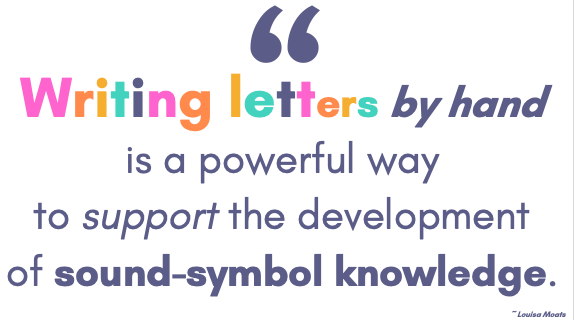
As Ehri, Moats, Graham & Hebert remind us, “Writing letters by hand helps children learn them more effectively, supports spelling, and contributes to the development of fluent reading.”
Think of handwriting as the paintbrush for your students’ ideas. It makes reading, spelling, and writing clearer and more automatic (Berninger, 2012).
Resources
If you’d like ready-to-use handwriting pages for every grapheme you teach, check out my Handwriting for Phonics Resource.

Find this handwriting resource here.
I prefer worksheets over a workbook because the spine always gets in the way! A nice, clean sheet of paper doesn’t add any extra frustration. Kids can focus on writing neatly without struggling to keep the page flat. Plus, you can pull just the pages you need, and it’s so much easier for kids to slide one page onto a clipboard, into a folder, or onto a slant board for better handwriting posture.
If I want my students to practice more than once, I like to slip these into a plastic page protector. For this, I would provide those extra skinny dry-erase markers!
And finally, you can extend it by having them flip it over to the back for some dictated sentences! I included just a page with lines so you could copy two-sided if you wanted!
References
- Berninger, V. W. (2012). Strengthening the Mind’s Eye: The Case for Continued Handwriting Instruction in the 21st Century. Principal, May/June 2012. (Find it here)
- Ehri, L. C. (2014). Orthographic mapping in the acquisition of sight word reading, spelling memory, and vocabulary learning. Scientific Studies of Reading, 18(1), 5–21. (Find it here)
- Graham, S. (2009). Want to Improve Children’s Writing? Don’t Neglect Their Handwriting. American Educator, Winter 2009–2010. (Find it here)
- Graham, S., & Harris, K. R. (2005). Improving the writing performance of young struggling writers: Theoretical and programmatic research from the Center on Accelerating Student Learning. Journal of Special Education, 39(1), 19–33. (Find it here)
- Graham, S., & Hebert, M. A. (2010). Writing to Read: Evidence for How Writing Can Improve Reading. Alliance for Excellent Education, Carnegie Corporation of New York. (Find it here)
- Moats, L. C. (2020). Speech to Print: Language Essentials for Teachers (3rd ed.). Paul H. Brookes Publishing. (Amazon affiliate link here)
- International Dyslexia Association. (2021). Handwriting and Spelling: Dyslexia Connection. Retrieved from https://dyslexiaida.org/